Tuesday, March 31, 2015

IEC 61850-9-3: Precision Time Protocol Profile for Power Utility Automation

IEC TC 57 has published the other day:

IEC/PAS 61850-9-3 (57/1551/PAS):
Communication Networks and Systems for Power Utility Automation –
Part 9-3: Precision Time Protocol Profile for Power Utility Automation

Voting terminates on 2015-05-01

The intent of this publication is to present a widely agreed technical solution for a precision time protocol (PTP) profile of IEC 61588:2009 applicable to power utility automation. There is urgent need in the power industry for a appropriate profile for power automation application to be defined in IEC 61588. This PAS (Public Available Specification) is intended to temporarily be used as a reference.

This allows to meet the highest synchronization classes of 108 IEC 61850-5 and IEC 61869-9.

IEC 62351-9: Cyber Security Key Management for Power System Equipment

IEC TC 57 has published the following draft standard:

IEC 62351-9 Ed.1 (57/1565/CD):
Power systems management and associated information exchange – Data and communications security – Part 9: Cyber security key management for power system equipment

Closing date for comments is 2015-07-03.

IEC 62351-9 specifies how to generate, distribute, revoke, and handle digital certificates and cryptographic keys to protect digital data and its communication. Included in the scope is the handling of asymmetric keys (e.g. private keys and X.509 certificates), as well as symmetric keys (e.g. session keys).
This part assumes that other standards have already chosen the type of keys and cryptography that will be utilized, since the cryptography algorithms and key materials chosen will be typically mandated by an organization’s own local security policies and by the need to be compliant with other international standards. This document therefore specifies only the management techniques for these selected key and cryptography infrastructures. The objective is to define requirements and technologies to achieve interoperability of key management.

Data and communications security are very crucial for the future power delivery system – take the various documents of the series IEC 62351 very serious!

Friday, March 27, 2015

How to Migrate to Internet Protocol Version 6 (IPv6)?

IEC TC 57 just published a new draft document for a future Technical Report:

IEC 62357-200 TR (57/1563/DTR):
Power systems management and associated information exchange –
Part 200: Guidelines for migration to Internet Protocol version 6 (IPv6)

Application: Utility communications using utility-owned and leased networks, including, but not restricted to communication within substations, from substation to substation, from substation to control center / maintenance center, control center to control center, energy management systems, synchrophasors, distributed and bulk energy generation and storage resources and (including fossil fuel plants and renewables) wind-, and solar power generation, storage, demand side management, and demand response for distribution level consumers / producers.

This draft Technical Report addresses the issues encountered when migrating from Internet Protocol version 4 (IPv4) to the Internet Protocol version 6 (IPv6). It describes migration strategies, covering impact on applications, communication stack, network elements, configuration, address allocation, cyber security, and the related management.

The migration will add new need and require more skills of the engineers. It is highly recommended to have some people that start learning the changes that will come during the next 30+ years.

Maybe you start with a small group as we did in the standardization process 15+ years ago in Seattle (WA) in 1999:

CB_1_2

Teamwork makes the dream work!

Be aware that the “network infrastructure” becomes one of the most crucial basics for all other infrastructures.

Would your company’s communications infrastructure survive a blackout like the one in The Netherlands today (2015-03-27)?

“Dutch electricity network administrator Tennet says that a large part of North Holland province, which is home to some 2.7 million people, was hit by the outage.

Tennet said on its Twitter feed that the outage was caused by a “technical fault” a high-voltage power station in the town of Diemen, just outside Amsterdam.”

Source: The Independent

I hope it was not caused by an “unknown” GOOSE Trip Message! … Which – at least – would mean it was not related to TCP/IP … IPv4 or IPv6. I am kidding! … a bit.

Out-Of-Range Quality Flag and Reporting Quality-Change Event

In addition to the following two discussions that contain a view on measured values:

What Does Complexity of a Protocol Mean-
Are you prepared for the Solar Eclipse 2015 on March 20-

I will now look into the possibility to automatically monitor and report the limit violation of a measured value using standard configuration of IEC 61850 Information Models (LN STMP1), Data Sets and Report Control.

There are two options to report the temperature value reaching the maximum possible value: using the quality information of the “Tmp.q” (configured by the configuration of the “max” value in “rangeC”) or the “Alm” (configured by “TmpAlmSpt”) as depicted in the following figure:

Idee_20150327_091258_01

We need to configure a Data Set and a Report Control Block for each case. In case of using “q” we have to communicate and interpret the “q” value “questionable and out of range” (which is a bit pattern!). In case of using the alarm data object “Alm” we just send and receive a simple Boolean value “True”. There is no need to interpret a bit pattern.

For machines it should be no big difference to analyze a bit pattern or a Boolean value.

Both approaches would provide the information that a measured value is higher than a specific limit (max or alarm limit). Which one you would like is up to you.

It is recommended that for specific domains it is specified in a “profile” document, which option to use. Maybe you want to use both: the “q” for asset management and the “Alm” for Automation functions to automatically start a cooling system. The “Alm” could easily be used for GOOSE messaging to inform a wide range of subscribers of the alarm …

The nice thing is that you can easily configure the multiple options just by SCL !! No programming needed – if the values of “q” and “Alm” are provided by the application.

Lesson learned: First define your need – then design the behavior of your Report and GOOSE messaging. If you don’t know what you want to accomplish, no standard can help you.

Friday, March 20, 2015

Germany Survived the Solar Eclipse 2015 on March 20

During the last days and months there were a lot of discussions and news about a possible blackout during the Solar Eclipse 2015 today. The operators (and the nature) were quite well prepared for the event.

Lesson 1 learned: Nature and Operators did a good job!

Is there another lesson learned? Sure!

Due to the fact that the universe is not made by human beings, we could predict the movement of the sun, the moon and the earth … and thanks to mathematics we could calculate the impact of the sun on a sunny day like today …

image

Source: ENTSO-E; click HERE for further details provided by ENTSO-E.

The first maximum of PV power feed-in of 13.3 GW was at 9:45 h today. One hour later the minimum feed-in was 5.1 GW at 10:45 h.

image

Source: SMA, click HERE for the online data (then select March 20, 2015).

Between 10:45 h and 11:45 h the feed-in grew by 11,7 GW. That means 195 MW per minute or 3,25 MW per second. The maximum of the day was 20.3 GW at 12:45 h.

image

Source: SMA, click HERE for the online data (then select March 20, 2015).

Note that the forecast was very accurate, as can be seen in the following diagram:

image

Source: TransnetBW; click HERE for the online data.

The forecast of March 13, 2015 (one week before) was some 700 MW higher than the actual value for 13:00 h, as can be seen in the following figure:

image

Source: TransnetBW; click HERE for the online data.

The transmission companies have spent a lot of money to get a very precise forecast for today – and it worked fine. But these efforts were taken because it was a remarkable day. The forecast may become better – they are still modeling the physical world with laws set by the creator of the nature. The future power system will be impacted by more man-made “laws” that focus more on profit than on physics.

How many power plants have been used today to control the frequency and balance the load and generation? Maybe a few hundred. These power plants are well equipped with remote terminal units and communicate through IEC 60870-5-101 (and some with -104).

The control center are able to control remotely in the context of schedules plant for the day.

Another question is: What if we have to control Millions of decentralized resources (in some years)? What if we have not only 40+ GW Wind Power and 50+ GW PV power installed?? Who will provide the needed schedules for millions of feed-in points? Who and how will we control millions of these resources?

And how will we guarantee that the needed communication links between millions of intelligent devices will operate in a disaster situation? Note: TODAYs Solar Eclipse was far away from a disaster!

And what happens if somebody manipulates the information and information exchange? Even if we limit the active control commands to a very few or forbid them at all. We need to exchange at least situational information: current, frequency, voltage, power factor, or … Who guarantees that the values exchanged can be trusted?

Can we then trust that we know all communication connections that end in a power plant? You would be surprised if you would start to list the communication assets. As an expert recently said: “I have had the same experience as … with respect to finding "unknown" remote access connectivity at almost every facility I have assessed. These include dial-up modems, wireless access points, and network interface cards that IT and Corporate Engineering did not know existed.” Somebody else said: “At another facility we were told that external connections were always unplugged, but we were able to call the equipment at the phone number we saw posted.”

The future of our power delivery system is dependent on millions (instead of hundreds) of power resources, and on human beings that may loose the control over the communication infrastructure or that may compromise the communication and control systems.

Lesson 2 (to be learned by all): Take the communication, secure communication, control, secure control, impact of the physics on the power system and other aspects MORE SERIOUS! Think always how to apply standards – I mean real standards like IEC 60870-5-104, IEC 61400-25, IEC 61850, or DNP3.

There is a lot to be accomplished at the engineering level! Power is more than Euros and Dollars … let’s do the job together. We need you all.

All people that have read to this end will agree with me (at least in general).

Thanks for taking your (spare!?) time.

Wednesday, March 11, 2015

What Does Complexity of a Protocol Mean?

There is always a discussion on one protocol being more efficient and less complex than another or all other. Does this discussion help? I don’t think so.

The key issue is the “SYSTEM” – which is MUCH more than a protocol.

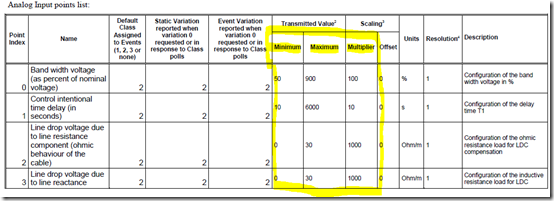
Let’s discuss briefly the configuration of a device with regard to reporting a value based on a deadband configuration and the range and multiplier of an analog value.

Usually the deadband values and range configurations and other crucial information are specified in a pdf file or – if you are lucky – in an excel sheet or XML file. So, to interpret a message the receiver has to know the configuration. The tables contained in the pdf file (below) have to be translated by somebody manually … and how can I find out in 10 years from now, what the limits of the Band width voltage are? Hm. No idea?! Usually you cannot ask the device. So, what now?

I am sorry, if you don’t have the pdf you may guess what the limits are – but you don’t know. Maybe somebody from the vendor is still there and can answer the question.

Example of a DNP3 SPECIFICATION - DEVICE PROFILE

Excerpt on deadbands and configuration:

image

image

A good thing is, that many vendors publish these files. Sur, you never know if they are up-to-date or applicable for your device you installed some time ago.

The information models of IEC 61850 provide dedicated attributes for a value that provide these meta data like deadband configuration, min, max, multiplier, SIUnit. These attributes could be used in the corresponding SCL file only or they could additionally be exposed by the device and made accessible through a simple read message.

With IEC 61850 in place we could easily expose the limits of power production and load and further attributes. The logical node MMXU (IEC 61850-7-4) could be used for the limits in which a value is valid:

Data Object TotW of class MV (measured value, IEC 61850-7-3) - Total active power (total P)

could provide the actual value, quality, range, Scale, limits, units, deadband in the details provided through the MV CDC:

mag.f deadband filtered AnalogueValue coded as floating point
q Quality
range ENUMERATED normal|high|low|high-high|low-low (out of range would change quality value)
rangeC RangeConfig:
hhLim
hLim
lLim
llLim
min
max
sVC ScaledValueConfig (scale and offset) for Integer values
db Deadband filter in % of range (min – max)
units SIUnit and multiplier

min: the min (minimum) attribute shall represent the minimum process measurement for which values of i or f are considered within process limits. If the value is lower, q shall be set accordingly (validity = questionable, detailQual = outOfRange).

max: the max (maximum) attribute shall represent the maximum process measurement for which values of i or f are considered within process limits. If the value is higher, q shall be set accordingly (validity = questionable, detailQual = outOfRange).

In our case, the TotW for the CHP generator may be limited between 0 W (min) and 35 kW (max). A value of “minus 600” MW would have to be flagged as questionable and outOfRange !! Negative values and values higher than 35 kW would be flagged out of range!

The receiver (a control center) could check the limits of the values (either by reading the range configuration online by a service or getting it from the corresponding SCL file). It could figure out that the range is 0-35 kW. Even if the gateway (RTU) would send “minus 600” MW (load) … the CC could understand that this is a bad value – recommended not to use.

The ScaledValueConfig exposes the scale factor and offset value – required to interpret an integer value.

The deadband db defines when to report a new value: when a change of the value is “+/- db of the range”: a range of 100 A and db=2000 (2 %) means –> every change of 2 A will be reported; the last reported value was 78 A, then the next report will be issued when the value reaches 76 A or 80 A.

The units contain the SIUnit (e.g., A) and the multiplier (10**0 –> 1).

The meta-data of the measured value serve as a means to help interpreting the plausibility and validation of a value communicated.

To focus on a message “Report a changed value based on a deadband configuration” and discuss which protocol does it more efficient is not helpful! Modbus can communicate the total Power – as can any other protocol. But: HOW to INTERPRET a received value? Is the value within the limits defined for an application? Is the value given in W, kW, MW or GW??

A system should be able to provide more than just A value – all crucial meta data that help to interpret the value are needed in any case. Either you get it – or …

Please focus on the “System” – a holistic approach is what we need.

This blog post will likely not stop protocol efficiency discussion … ok. And?

If it makes you happy when you discuss protocol issues … do it.

Saturday, March 7, 2015

Are you prepared for the Solar Eclipse 2015 on March 20?

Why raise such a question on this blog that is about standards like IEC 60870-5-104 and IEC 61850 …? These are two good questions. Let’s discuss them briefly.

The Solar Eclipse 2015 and its impact on the power transmission system is discussed these days. The crucial issue is the minute-to-minute power gradient that may exceed between minus 400 MW/minute and plus 700 MW/minute; the highest gradient occurs when the PV in-feed returns at the end of the phase. This gradient may be managed by the TSO or not – who knows. We know it at lunch time on March 20, 2015.

There are many recommendations on the web, how to get prepared: having water, food, … for up to 10 days or so … I hope we will not need these.

@Question 2:

There is a need for the TSOs (just four in Germany!) to relay on good measurements from all-over in the grid and secure control possibilities to manage power plant in-feeds and substations. I guess they have good communication systems they can trust. These systems have been developed over many decades. They are tested and run reliably. Still. But what happens in future where we will have hundreds or millions of technical systems (embedded controllers …) that contribute to the system view and management?? Is this an issue at all?

Yes, it is a crucial issue. Let me discuss the following real-life incident reported last week:

A gateway in a virtual power plant provides the measured load on the network connection point of a CHP (combined heat and power) system. Normally the CHP feeds power into the network. But all in a sudden the VPP/TSO received a signal telling them a jump of the load from 0 MW to 600 MW!! Should the control center responsible for that part of the grid act or not? Hm. If this would be a real jump then it would have to react.

(Un)Fortunately the 600 MW jump was just a jump in the Value communicated!! It was caused by an error in the gateway (RTU kind of device). Was this value plausible? No. Because the CHP could just feed-in – not draw that much power from the grid.

With IEC 61850 in place we could easily expose the limits of power production and load. The logical node MMXU could be used for the limits in which a value is valid:

Data Object TotW of class MV (measured value) - Total active power (total P)

could provide the actual value, quality, range and the limits in the details provided through the MV CDC:

instMag.f AnalogueValue coded as floating point
q Quality
range ENUMERATED normal|high|low|high-high|low-low (out of range would change quality value)
rangeC RangeConfig:
hhLim
hLim
lLim
llLim
min
max

min: the min (minimum) attribute shall represent the minimum process measurement for which values of i or f are considered within process limits. If the value is lower, q shall be set accordingly (validity = questionable, detailQual = outOfRange).

max: the max (maximum) attribute shall represent the maximum process measurement for which values of i or f are considered within process limits. If the value is higher, q shall be set accordingly (validity = questionable, detailQual = outOfRange).

In our case, the TotW for the CHP generator may be limited between 0 W (min) and 35 kW (max). A value of “minus 600” MW would have to be flagged as questionable and outOfRange !! Negative values and values higher than 35 kW would be flagged out of range!

The receiver (a control center) could check the limits of the values (either by reading the range configuration online by a service or getting it from the corresponding SCL file). It could figure out that the range is 0-35 kW. Even if the gateway (RTU) would send “minus 600” MW (load) … the CC could understand that this is a bad value – recommended not to use.

The meta-data of the measured value serve as a means to help interpreting the plausibility of a value communicated.

IEC 61850 models add very useful information to help (a bit) keeping the power flowing. There are many other physical issues to take into account … but information and information exchange plays a crucial role!

Friday, March 6, 2015

What about security for SCADA systems?

Since the early 80s we have discussions on open systems. I remember well people saying in 1984: If you want open systems – you must be crazy. True! If you don’t shut the doors of the access and let only those in that are allowed to.

There are measures to secure the access – but they have to be implemented and used. There are a lot of concerns about embedded systems on the internet and security.

Read this up-to-date story – and you may not sleep tonight:

Journalists warned system owners and Norwegian NSA of 2500 critical data flaws

How two journalists set out on a mission to test the data security in the whole of Norway

Excerpt:

“Thus far, they have found:
• 290 vulnerable control systems, in banks, schools, nursing homes - and a military camp
• 2048 surveillance cameras in private homes, night clubs, shops and restaurants
• 2500 control systems connected to the Internet with minimal or no security
• 500 of these control industrial or critical infrastructure
• Thousands of data bases and servers that give away content without passwords

These are all found in Norway. Guess if it is any better in your country?”

Click HERE for the report.

And YOU? Become more serious about security!!! For the good of you and all of us – all over.

And do not blame IEC 61850 not providing security measures! It has: IEC 62351 shall be applied – but you gave to do it! Do it!

http://blog.iec61850.com/2015/02/standard-iec-62351-3-communication.html

How to get prepared using IEC 61850?

How to get prepared using IEC 61850? This is one of the crucial questions these days. Fortunately there is an increasing number of organizations that understand the challenge with the IEC 61859 technology – and get training and education.

The A.C. electric power system is a very dynamic physical system. Could you remember the exam on Electro Dynamics when you were a student? Oh, don’t remind you … it was (is) a horror for many electrical engineers – also for me. Even some 40 years later, we have the same challenge with the dynamics of the electrical system. It is more complex these days because of the integration of thousands and millions of “power stations” into the system. The need for a good base knowledge of the electric system COMBINED with the need to get familiar of using an increasing information exchange to monitor and control the electrical system will be the prerequisites for the future electrical engineers.

I  have seen several utilities, vendors, and institutes that are very serious when it comes to the use of IEC 61850 based IEDs in substation designs. A lot of money has been invested in building network simulation systems that can be used in a lab to test IEC 61850 based protection, control and remote monitoring schemas. This is the only way to prove the concepts for a particular application domain. The financial situation of many utilities does not allow to invest into a comprehensive lab.

The education of students is very crucial. I was quite happy to read about a new lab at the Victoria University (VU) in Melbourne. They are “about to become a cornerstone for integrating smart grid technology into Australia’s electricity supply market, with the development of one of the world’s only (if not first) Zone Substation Simulator Centre (VZSSC).

The Centre will simulate 66 to 22 KV substation environments (specifically a two-transformer zone substation with dual MV buses), control and protection schemes using the IEC 61850 technology standard for the automation and control designs.
Whilst a breaker and a half configuration will define the sub-transmission side, the protection and control setup will encompass a specific X & Y protection scheme.”

Congratulation to Dr Akhtar Kalam and Graeme McClure that succeeded in convincing enough people to spend money to make this happen!

There is another group of people that need education in IEC 61850: Senior and junior protection and electrical engineers that have long term experience in substation automation, protection, and remote access.

Many of these engineers may have heard some stories about the use of IEC 61850 for power systems – but may have only a chance to read the many parts of the IEC 61850 standards … good luck. Reading the standards? It is more efficient to get a training conducted by senior engineers that could help you to speed up.

Click HERE to see what two senior engineers provide: Protection engineer Andrea Bonetti (FMTP) and communication engineer Karlheinz Schwarz.

Click HERE for a full description of the lab at the Victoria University (VU) in Melbourne.

Additional information of using IEC 61850 and IEC 61499 in Distributed Power Systems .. zone substations …:

Distributed Power System Automation With IEC 61850, IEC 61499, and Intelligent Control (Neil Higgins, Member, IEEE, Valeriy Vyatkin, Senior Member, IEEE, Nirmal-Kumar C. Nair, Senior Member, IEEE, and Karlheinz Schwarz, Member, IEEE; IEEE TRANSACTIONS ON SYSTEMS, MAN, AND CYBERNETICS, 2010)

Multi-agent Smart Grid Automation Architecture based on IEC 61850/61499 Intelligent Logical Nodes (G. Zhabelova, V. Vyatkin, Senior Member IEEE; IEEE Transactions on Industrial Electronics, 2011)

Saturday, February 21, 2015

Neues vom Verein VHPready – E-World Messeerfahrung

Sie finden auf der Website von VHPready sehr interessante Berichte zur Messe E-World und Beiträge:

- das White Paper zu VHPready 4.0

- ein Résumé zum E-world Messeauftritt des Industrieforums

- die Presseinformationen zur E-world

- die Vortragsfolien zu einem VHPready-Vortrag im „Energy Transition“ Forum der E-world

- eine Veröffentlichung in den „Energie & Management Powernews“, in der LichtBlick und Fraunhofer FOKUS zu Wort kommen.

Weiterhin ist die Kurzdarstellung der VHPready Services GmbH (i.G.) inzwischen auch auf Englisch verfügbar.

Einige Aussagen von Besuchern auf dem Messestand:

„Angesichts der vielen auf der Messe gezeigten Szenarien Virtueller Kraftwerke wird die Dringlichkeit von Standardisierung deutlich.“

„Wir haben uns beim Messerundgang schon gewundert, wie die vielen proprietären Lösungen zusammenspielen sollen. Endlich haben wir jemanden gefunden, der sich um die Standardisierung der Kommunikation kümmert!“

„Endlich ein Standard, der auf praktischen Erfahrungen beruht und nicht von anwendungsfernen Technokraten gemacht wurde.“

„Sehr gut, dass Ihr von Beginn an international denkt!“

IEC 61850: Protection and SCADA Seminars (updated)

The IEC 61850 applied for several years to many new substation designs all over the world. During the seminar, truly experienced and vendor independent engineers will help you to see and understand how use the core parts of the IEC 61850 standard are applied in substation design, monitoring, protection and control applications.

Attendees will learn from a senior protection engineer, how the protection system will improve and understand the crucial lessons learned since the first projects with IEC 61850 in 2004.

Seminar contents:

IEC 61850 Introduction (Edition 1, 2, and 2.1) and experience after 10 years in operation. Where are we today?

Return of experience, applications and practical demonstrations: Protection and Control in Substation Automation, Engineering and Configuration, Maintenance, Monitoring and SCADA system, Specification of the IEC 61850 protection and control system.

Through the practical demonstrations you will learn: To handle IEC 61850 relay protections from different vendors and their software tools; to be able to efficiently manage flexibility in engineering and interoperability. To use the state of the art IEC 61850 testing tools and equipment to efficiently detect the technical problems and work-out their solutions. To understand SCL files, setup clients and servers for MMS communication to SCADA and RTU Systems All the presentations are supported by practical examples or demonstrations.

The following 3 days special training courses are offered by FMTP (Uppsala, Sweden) and NettedAutomation:

Hong Kong
27-29 April 2015
Details and registration

Berlin (Germany)
05-07 May 2015
Details and registration

Bratislava (Slovakia)
18-20 May 2015
Details and registration

Brussels (Belgium)
08-10 June 2015
Details and registration

I look forward to seeing you there.

Saturday, February 14, 2015

VHPready Signal MMXU1.TotW.instMag – versus IOA 113

Signals configured in IEC 61850 and configured in IEC 60870-5-104 look quite different.

The following figure shows the same signal (Current electric Power – Aktuell erzeugte elektrische Leistung) in IEC 61850 (left) and IEC 60870-5-104 (right):

image

The IEC 61850 model exposes the value, quaity and timestamp as well as the semantic (TotalWatt). The total watt of what? Of the “Current electric Power – Aktuell erzeigte elektrische Leistung” as described in the DC (description of the signal).

On the other side we have the information object address (IOA = 113) that carries the same value in IEC 60870-5-104. What does the value 3456 mean? No idea in IEC 60870-5-104. You have to know upfront what 113 means. IEC 61850 stores the meaning in the device (model).

In the above case we see also the IOA=113 in the description (DC) of the IEC 61850 model. It is a text string attached to the DC attribute.

Monday, February 9, 2015

IEC 61850 Series is Growing to a Total of 45 Parts

IEC 61850 (Communication networks and systems for power utility automation) is a unique standards series providing a consistent set of standards, draft standards and other IEC publications.

A total of 45 parts cover many application domains in the Power Delivery System. An additional five (5) parts are published under the number IEC 61400-25 (extensions of IEC 61850 for Wind Power).

Document types of IEC:
IS = Standard
TR = Technical Report
TS = Technical Specification

21 Parts are already officially published. 24 draft parts are under preparation. Several drafts will be officially published in 2015.

The list of all documents:

image image image

In order to keep the crucial contents (mainly models and services) of these parts consistent, IEC TC 57 WG 10, 17, and 18 have done a tremendous work in converting the crucial contents into UML documents. This allows to extend and maintain the models with support of tools. In future we will see standard documents automatically derived from the UML Models.

Congratulation to all people contributing to this great standard series IEC 61850!

Some 20 years after the IEC TC 57 has decided (in 1995) to write a new standard for substation protection and automation, we see a lot of interest in many different application domains.

In case you need help to understand the many different parts and how they could contribute to solve needs you are faced with today and tomorrow – let me know please.

Even IEC 61850 is a huge Standard Series – it must be accompanied by REAL APPLICATIONS and underlying network infrastructure. The 7 ISO/OSI layers are just a foundation for IEC 61850 – both together are used by applications:

image

The applications of IEC 61850 can range from a simple polling of a temperature measurement up to comprehensive Schedules to manage distributed energy resources.

By the way: Te cake was very tasty!

Saturday, February 7, 2015

Standard IEC 62351-3 “Communication network and system security - Profiles including TCP/IP” published

IEC TC 57 has published the crucial standard for security:

Standard IEC 62351-3
Power systems management and associated information exchange - Data and communications security -
Part 3: Communication network and system security - Profiles including TCP/IP

Partie 3: Sécurité des réseaux et des systèmes de communication – Profils comprenant TCP/IP

image

This part of IEC 62351 specifies how to secure TCP/IP-based protocols through constraints on the specification of the messages, procedures, and algorithms of Transport Layer Security (TLS) (defined in RFC 5246) so that they are applicable to the telecontrol environment of the IEC. TLS is applied to protect the TCP communication. It is intended that this standard be referenced as a normative part of other IEC standards (e.g., IEC 60870-5, IEC 60870-6, IEC 61850, IEC 61400-25, …) that have the need for providing security for their TCP/IP-based protocol.

Now it is up to the vendors and users to implement this standard or require it, respectively.

There is no accuse anymore that IEC 61850 has no security measures defined in form of a standard that can officially be referenced.

Click HERE for the preview of the new standard.

Thursday, February 5, 2015

Visit Booth of VHPready at E-World 2015 in Essen

The industry alliance VHPready e.V. will present the project at the E-World 2015 in

Essen (Gemany)
10. - 12. February 2015
Halle 6, Stand 109

Co-exhibitors are:

  • Fraunhofer FOKUS (co-exhibitor)
  • Beck IPC GmbH (co-exhibitor)
  • SSV Software Systems GmbH (co-exhibitor)
  • PHOENIX CONTACT Electronics GmbH (co-exhibitor)

You could see the IEC 61850 (and IEC 60870-5-104) Model of VHPready 3.0 in action … seen through an IEC 61850 Browser:

image

Have a look at the booth!

Sunday, February 1, 2015

HMS: Bridging Fieldbus Communication to Power Automation

HMS (one of the most crucial supporter of field busses for industrial and process Automation) brings the huge installed base of field instrumentation closer to the power automation and vice versa. With the new approach customers can tap and exchange crucial process information with the most successful power communication standards like IEC 60870-5-104 or DNP3 and others.

HMS provides a new family of products for smart grid applications using IEC 60870-5-104, IEC 61850, Modbus, Profibus, Profinet, HART, …: The LABLINE SG gateway family targets Demand Response (networking of industrial electric loads) and Virtual Power Plants (networking of energy resources like biogas plants or combined heat and power units) applications.

NettedAutomation’s Motto since 2000 is: The NET is The Automation. Networking is really crucial – and also to understand what this all means! Do you know how to bridge the gaps between signals communicated with Profibus DP and IEC 60870-5-104? HMS has the solution to bridge almost all gaps between factory and process instrumentation field busses and the power world.

Remote Terminal Unit
The LABLINE SG devices support the communication protocols used in the energy sector, e.g. IEC60870-5-104, DNP3 and IEC61850; as well as protocols supported by the electric equipment in the field, e.g. Modbus or M-Bus. The LABLINE SG gateways can also communicate with industrial fieldbus or industrial Ethernet networks such as Profibus, Profinet or any other industrial network thanks to their Anybus technology.

Smart Gateway 
The application logic can be programmed on the device either using a graphical web editor or for more complex applications through the embedded soft-PLC from CODESYS compliant to IEC61131-3 standard.

Click HERE for more details of the new family of products.

More to come.

Seminar Schedule of FMTP and NettedAutomation updated

The need for solid education and hands-on demonstrations and hands-on training is more obvious at the beginning of 2015 than ever before.

FMTP and NettedAutomation have updated their public training courses. The following public courses for the next months are scheduled:

23-25 März Karlsruhe Almost Sold Out:
3-tägiges Seminar & Hands-On Training in Deutsch
05-08 May
13-16 Oct
Frankfurt NEW General Public Courses in ENGLISH
27-29 April Hong Kong Special Public Courses in ENGLISH for Protection Engineers and SCADA Applications
18-20 May Bratislava(Slovakia) Special Public Courses in ENGLISH for Protection Engineers and SCADA Applications
08-10 June Brussels (Belgium Special Public Courses in ENGLISH for Protection Engineers and SCADA Applications

Click HERE for details.

According to the many enquiries FMTP and NettedAutomation received, we are negotiating with several groups all over.

The most efficient courses are in-house training courses – appreciated by many well known international companies all over.

Stay tuned to see updated schedules and news. Or contact us for more information.

IEC 61850 is more than just a “Future Trend”

A manager from a big Asian power utility wrote me the other day:

“Dear Karlheinz,
… because of the schedule of my visit to the CIGRE2014 session at Paris, also an overseas trip for our protection experts to XXXX at Nanjing and YYYY at Tokyo in late September 2014. For one thing that I could learn from both trips, IEC 61850 should no longer be called a "future trend" for the power industry, as it is already the adapted practice everywhere! Just you know it is always not easy to implement new standards in the utilities, especially talking about some well-established ones ...”.

The standard series IEC 61850 is now available for some 10 years. Many manufacturers of automation systems have implemented a reasonable subset of the standards. It’s in use all over. Don’t worry if your management has still to be convinced to implement or use the standards. It takes some time to get there.

It may happen that in some cases you may have to wait for one or two retirements …it’ll come.

Note: Haste produces waste. Take your time – in the meantime get yourself and your people trained to understand what it is all about.