Showing posts with label Power Automation. Show all posts

Monday, February 10, 2025

IEC 61850-7-410 ED3 CDC - Hydroelectric Power Plants Available for Public Commenting

Please note that last Friday IEC TC 57 has published the following Committee Draft for Vote (CDV) (57/2750/CDV) for comments by National Committees AND for public commenting by anybody before April 04, 2025:

IEC 61850-7-410 ED3: Communication networks and systems for power utility automation - Part 7-410: Basic communication structure - Hydroelectric power plants - Communication for monitoring and control 

To comment on the CDV please click HERE. If you have not yet an account you can register ... if you have an account, go on. (IEC reports: Please use Google Chrome or Microsoft Edge).

IEC Public Commenting is a chance to let your voice be heard before the final vote.

This draft is a major step forward to get an international standard for hydroelectric power plants, steam and gas turbines.

Saturday, December 9, 2017

How many employees will drive an electric vehicle?

A German manager recently said that 500 employees of his company drive by car to the company every workday. He expects that in the future 250 will use electric cars and will charge their cars within the first hour after they arrived. The company would need 10 times more power than today!
Ok! Hm!?
What do you think about these assumptions? 250 EVs charging in the first hour!?
As an engineer I am wondering that experts come up with such examples. First of all, I do not expect that 50 per cent of the car owners will buy an electric car in the next years. Even if they would do, why do 250 car drivers want to charge at the companies car park in the morning when they arrive?
He concludes that "we engineers have not yet thought through to the end".
I guess a lot of engineers have thought through to the end - but not many engineers or politicians are listening!

Click HERE for the report "Netzstabilität braucht Digitalisierung und Automatisierung" in the vdi nachrichten (German).

These discussions remind me of the situation in the early 80s when we had the discussion on CSMA/CD (Ethernet, IEEE 802.3) versus Token Passing (IEEE 802.4). Under the assumption that we have a shower of messages to be sent by all attached devices at the same time, we found that Ethernet could not efficiently manage the communication due to many collisions. Token Passing was understood to manage such a situation very well. Ok.
Another assumption, high load from one device only, could easily be managed by CSMA/CD - but Token Passing would end up in very low throughput ... many other assumptions could be made.
So, what is the realistic assumption for communication? Nobody knows - it all depends.
Finally Switched Ethernet (a major new development) solved the collision problem ... and Token Passing more or less became obsolete in the automation world.

In the energy domain we need first to find the future new mix of power generation and how to store, transmit, distribute, and use the power - then we can think about automation and communication. The most crucial issue may be: Who is paying for all the changes?

By the way: We (many engineers) know how to communicate: IEC 61850 is one of the most crucial solution ... and how (not yet what) to automate.

Monday, June 29, 2015

An Approach to Developing Power Grid Control Systems with IEC 61850 and IEC 61499 and Holonic Control

An interesting paper discusses the combined use of IEC 61850 and IEC 61499:

An Approach to Developing Power Grid Control Systems with IEC
61850, IEC 61499 and Holonic Control

by Valentin Vlad, Corneliu Buzduga, and Calin Ciufudean (University of Suceava, Romania)

WSEAS TRANSACTIONS on SYSTEMS, Volume 13, 2014

This paper presents some models and concepts for developing smart power grid control systems based on holonic concepts and the open standards IEC 61850, IEC 61499. Along with the proposed holonic models for different levels of control, we present a simple fault protection application illustrating how the IEC 61499 artifacts can be used for modeling and implementation of IEC 61850 compliant applications.

Click HERE for the above paper.

Additional information of using IEC 61850 and IEC 61499 in Distributed Power Systems:

Distributed Power System Automation With IEC 61850, IEC 61499, and Intelligent Control (Neil Higgins, Member, IEEE, Valeriy Vyatkin, Senior Member, IEEE, Nirmal-Kumar C. Nair, Senior Member, IEEE, and Karlheinz Schwarz, Member, IEEE; IEEE TRANSACTIONS ON SYSTEMS, MAN, AND CYBERNETICS, 2010)

Multi-agent Smart Grid Automation Architecture based on IEC 61850/61499 Intelligent Logical Nodes (G. Zhabelova, V. Vyatkin, Senior Member IEEE; IEEE Transactions on Industrial Electronics, 2011)

More to come.

Saturday, May 2, 2015

Could a Power Outage of an Airplane happen in the Air?

Yes, a power outage of an modern airplane could be caused by a simple software problem – related likely to a wrong assumption. What does this mean for the future power systems?

The following official report from the U.S. Government FAA, dated May 01, 2015 says that a

Boeing Model 787 airplane that has been powered continuously for 248 days can lose all alternating current (AC) electrical power due to the generator control units (GCUs) simultaneously going into failsafe mode. This condition is caused by a software counter internal to the GCUs that will overflow after 248 days of continuous power.

The software counter internal to the generator control units (GCUs) will overflow after 248 days of continuous power, causing that GCU to go into failsafe mode. If the four main GCUs (associated with the engine mounted generators) were powered up at the same time, after 248 days of continuous power, all four GCUs will go into failsafe mode at the same time, resulting in a loss of all AC electrical power regardless of flight phase.”

Click HERE for the full report.

What is the lesson we can learn from this situation? I guess simply this: If you have to program something you need to know precisely under which assumptions the “something” should work. Usually you have to make firm assumption under which the “something” will work. If you would assume (for example) that an airplane of model 787 would never be powered continuously longer than 90 days, then the counter would not overflow under normal conditions.

But: If this assumption is wrong, then the counter could overflow.

I guess that we quite often design systems under assumptions that may be valid at time of the design – but that may show later that they were quite wrong! Some 40-50 years ago it was not assumed that the traffic in 2015 would be as is is now. Or?

The power utilities assumed some 15 years ago that PV-Power (mainly installed on roofs) should just be understood and treated as negative power connected to the grid – so that there was no need to invest in power management and automation systems. I remember such discussions in the German national standardization (DKE). Within a short time period they had to learn that the assumption was wrong! Now we have almost 40 GW of installed PV systems.

The next wrong assumption could likely be the number of Batteries connected to the power grid. The needed investment in the future power system will highly depend on the assumption on how fast the installation of batteries will happen! I have talked recently to utility experts that they fear a fast growth of network connected batteries. The batteries behave different compared to Wind Turbines and PV systems – batteries can import and export energy. They can change their behavior within very short time. A sudden huge power flow change of millions of battery systems could cause power outages.

So, MUST we assume that this could easily happens or not? Depending on our answer, we have do spent more or less Euros or Dollars … Experts that don’t want to invest a lot more will argue, that it is unlikely to happen.

The (wrong) assumptions of today could likely be the reasons of power outages in the near future. The bad side of the assumption that the installation of battery systems will grow fast is: It will require a lot of more efforts to keep the power system reliable.

I guess we will see increasing numbers of batteries being installed after yesterdays announcement (May 01, 2015) of the new Partnership for Global Energy Transformation: LichtBlick (Germany) integrates Tesla Battery Storage (US) into Energy Markets.

A crucial key component in the future power systems is related to information management and standardized information exchange with IEC 60870-5-104 and IEC 61850. VHPready is an important step to support LichtBlick and many other companies.

Thursday, April 9, 2015

Will Information Networks become the “Backbone” of the Power System?

Information sharing between any kind of intelligent devices is a crucial need for today’s an the future Power Delivery Systems. It requires a huge infrastructure to send information back and forth.

Who do you think will put a lot of efforts into the infrastructure to get control over the information to be shared? Will protection engineers or mechanical engineers (e.g., of wind turbines) gain control over the information infrastructure? I guess that it will work the other way around: The specialists of network infrastructure will have a big impact on how the information will be shared in future.

One of the many activities is supported by a special group within the IETF (Internet Engineering Task Force): Energy Management (EMAN)

Excerpt from the current Applicability Statement

Abstract

The objective of Energy Management (EMAN) is to provide an energy management framework for networked devices. This document presents the applicability of the EMAN information model in a variety of scenarios with cases and target devices. These use cases are useful for identifying requirements for the framework and MIBs.

1. Introduction

The focus of the Energy Management (EMAN) framework is energy monitoring and management of energy objects [RFC7326]. The scope of devices considered are network equipment and their components, and devices connected directly or indirectly to the network. The EMAN framework enables monitoring of heterogeneous devices to report their energy consumption and, if permissible, control. There are multiple scenarios where this is desirable, particularly considering the increased importance of limiting consumption of finite energy resources and reducing operational expenses.”

Click HERE for the current “Energy Management (EMAN) Applicability Statement, draft-ietf-eman-applicability-statement-10”

From an information sharing point of view there is no difference between information of a router or Ethernet Switch and a protection, monitoring or control IED (Intelligent Electronic Device) in the sense of a Fieldbus, DNP3, IEC 60870-5-104 and IEC 61850.

Finally IETF could play a major role in the world of networked devices – including everything that is believed today as somehow special: Field devices on one of the hundreds of fieldbusses, IEDs in the Power delivery systems, etc.

If you are looking for a unique (single standard) that is accepted and used all over the globe: It is IEC 61850. Use the ORIGINAL. A mapping of the IEC 61850 objects (IEC 61850 Logical Nodes and DataObjects) onto a MIB and SNMP could make sense – especially when the structures are used unchanged. The same is true for a mapping of specific MIBs for Ethernet Switches and Routers. This is already happening in IEC 61850-7-4 Ed2 for some network related information, e.g., in:

LN LCCH: Physical communication channel supervision:

image

More to come.

The motto of NettedAutomation GmbH since 2000 is: “The Net is The Automation”.

Tuesday, April 7, 2015

Secure Power Delivery Systems and Secure Communication

The power utility domain is facing a lot of challenges these days. There are environmental, technical, political, security-related, and market-related issues that require a new design of the whole chain of design, procurement, installation, operation and maintenance of systems that are needed to provide the needed power to the users of power.

There are tons of lists that require this and that. Take the cyber security aspect: You will find many documents that could help you to procure the right solution. One of the latest documents provides helpful text to write down the needs for “Cyber security of Power Delivery Systems”:

“Cybersecurity Procurement Language for Energy Delivery Systems”

Written by US-Experts and published last year.

Click HERE for a copy.

Many (likely most) publications on securing our infrastructure are assuming a mainly hierarchical and centralized Power Delivery and Automation Systems as described in the following (excerpt from the above document, page 1):

“Energy delivery systems comprise the following:

  • The sensors and actuators used for monitoring and controlling energy delivery processes.
  • The computer-based systems that analyze and store data.
  • The communication pathways and networks that interconnect the various computer systems.

Cybersecurity threats, whether malicious or unintentional, pose a serious and ongoing challenge for the energy sector. Today’s highly reliable and flexible energy infrastructure depends on the ability of energy delivery systems to provide timely, accurate information to system operators and automated control over a large, dispersed network of assets and components.

The cyber security requirements could be lowered dramatically in case we think of a more de-centralized Power System that would need a de-centralized Automation System over a small local system of assets and components – requiring a minimum of operational communication with the next hierarchy level.

It seems to be in the interest of manufacturers of network infrastructure to implement huge systems to control a large, dispersed network of assets and components. Sure: This would require a huge, secure network infrastructure – a huge and long-term business case. Cyber-Security seems to be a new support programme to the vendors of communication and automation infrastructure.

As we have experienced, more or less (intended!) simultaneous control commands to a huge number of assets could danger the stability of the power network. I guess that the risk in using a highly cyber-secure network (for monitoring and control) in a large hierarchical power system is much bigger than the risk of a “less” secure network (for monitoring and control) in small de-centralized, self-organizing power systems.

A cyber-secure network is one issue – the (physical and technical!) architecture of our future Power Delivery System is another.

Why don’t we pay more attention to distributed Power Delivery Systems that require distributed monitoring and control? Exchanging measurements, status, settings, and control commands in a huge hierarchical automation system will always be compromised by some people.

Would you trust an avalanche of measurements and status points arriving from millions of sensors communicated in a second? Would you trust that a setting going to millions of controllers will be interpreted in the same way? Or what’s about a control commands send out to ALL actuators? The un-thinkable is already a reality. It happened already last year in Bavaria and Austria.

I experienced the mis-interpretation of the power of my green laser pointer when I went through security of an international airport. My pointer has a power of “<1mW”. I was near to be arrested because the police officer was reading “one MegaWatt” … Fortunately I could help to translate “m” to “Milli”. Finally I had to check-in the pointer before I could go onboard.

I guess that one of the biggest challenges is to find an architecture of our future power delivery system that requires just a few or no measurements, status, settings, and control commands being exchanged between millions of interconnected intelligent devices and systems.

Friday, March 20, 2015

Germany Survived the Solar Eclipse 2015 on March 20

During the last days and months there were a lot of discussions and news about a possible blackout during the Solar Eclipse 2015 today. The operators (and the nature) were quite well prepared for the event.

Lesson 1 learned: Nature and Operators did a good job!

Is there another lesson learned? Sure!

Due to the fact that the universe is not made by human beings, we could predict the movement of the sun, the moon and the earth … and thanks to mathematics we could calculate the impact of the sun on a sunny day like today …

image

Source: ENTSO-E; click HERE for further details provided by ENTSO-E.

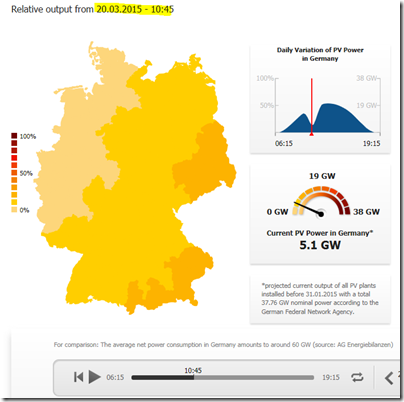
The first maximum of PV power feed-in of 13.3 GW was at 9:45 h today. One hour later the minimum feed-in was 5.1 GW at 10:45 h.
image

Source: SMA, click HERE for the online data (then select March 20, 2015).

Between 10:45 h and 11:45 h the feed-in grew by 11,7 GW. That means 195 MW per minute or 3,25 MW per second. The maximum of the day was 20.3 GW at 12:45 h.

image

Source: SMA, click HERE for the online data (then select March 20, 2015).

Note that the forecast was very accurate, as can be seen in the following diagram:

image

Source: TransnetBW; click HERE for the online data.

The forecast of March 13, 2015 (one week before) was some 700 MW higher than the actual value for 13:00 h, as can be seen in the following figure:

image

Source: TransnetBW; click HERE for the online data.

The transmission companies have spent a lot of money to get a very precise forecast for today – and it worked fine. But these efforts were taken because it was a remarkable day. The forecast may become better – they are still modeling the physical world with laws set by the creator of the nature. The future power system will be impacted by more man-made “laws” that focus more on profit than on physics.

How many power plants have been used today to control the frequency and balance the load and generation? Maybe a few hundred. These power plants are well equipped with remote terminal units and communicate through IEC 60870-5-101 (and some with -104).

The control center are able to control remotely in the context of schedules plant for the day.

Another question is: What if we have to control Millions of decentralized resources (in some years)? What if we have not only 40+ GW Wind Power and 50+ GW PV power installed?? Who will provide the needed schedules for millions of feed-in points? Who and how will we control millions of these resources?

And how will we guarantee that the needed communication links between millions of intelligent devices will operate in a disaster situation? Note: TODAYs Solar Eclipse was far away from a disaster!

And what happens if somebody manipulates the information and information exchange? Even if we limit the active control commands to a very few or forbid them at all. We need to exchange at least situational information: current, frequency, voltage, power factor, or … Who guarantees that the values exchanged can be trusted?

Can we then trust that we know all communication connections that end in a power plant? You would be surprised if you would start to list the communication assets. As an expert recently said: “I have had the same experience as … with respect to finding "unknown" remote access connectivity at almost every facility I have assessed. These include dial-up modems, wireless access points, and network interface cards that IT and Corporate Engineering did not know existed.” Somebody else said: “At another facility we were told that external connections were always unplugged, but we were able to call the equipment at the phone number we saw posted.”

The future of our power delivery system is dependent on millions (instead of hundreds) of power resources, and on human beings that may loose the control over the communication infrastructure or that may compromise the communication and control systems.

Lesson 2 (to be learned by all): Take the communication, secure communication, control, secure control, impact of the physics on the power system and other aspects MORE SERIOUS! Think always how to apply standards – I mean real standards like IEC 60870-5-104, IEC 61400-25, IEC 61850, or DNP3.

There is a lot to be accomplished at the engineering level! Power is more than Euros and Dollars … let’s do the job together. We need you all.

All people that have read to this end will agree with me (at least in general).

Thanks for taking your (spare!?) time.

Friday, March 6, 2015

How to get prepared using IEC 61850?

How to get prepared using IEC 61850? This is one of the crucial questions these days. Fortunately there is an increasing number of organizations that understand the challenge with the IEC 61859 technology – and get training and education.

The A.C. electric power system is a very dynamic physical system. Could you remember the exam on Electro Dynamics when you were a student? Oh, don’t remind you … it was (is) a horror for many electrical engineers – also for me. Even some 40 years later, we have the same challenge with the dynamics of the electrical system. It is more complex these days because of the integration of thousands and millions of “power stations” into the system. The need for a good base knowledge of the electric system COMBINED with the need to get familiar of using an increasing information exchange to monitor and control the electrical system will be the prerequisites for the future electrical engineers.

I  have seen several utilities, vendors, and institutes that are very serious when it comes to the use of IEC 61850 based IEDs in substation designs. A lot of money has been invested in building network simulation systems that can be used in a lab to test IEC 61850 based protection, control and remote monitoring schemas. This is the only way to prove the concepts for a particular application domain. The financial situation of many utilities does not allow to invest into a comprehensive lab.

The education of students is very crucial. I was quite happy to read about a new lab at the Victoria University (VU) in Melbourne. They are “about to become a cornerstone for integrating smart grid technology into Australia’s electricity supply market, with the development of one of the world’s only (if not first) Zone Substation Simulator Centre (VZSSC).

The Centre will simulate 66 to 22 KV substation environments (specifically a two-transformer zone substation with dual MV buses), control and protection schemes using the IEC 61850 technology standard for the automation and control designs.
Whilst a breaker and a half configuration will define the sub-transmission side, the protection and control setup will encompass a specific X & Y protection scheme.”

Congratulation to Dr Akhtar Kalam and Graeme McClure that succeeded in convincing enough people to spend money to make this happen!

There is another group of people that need education in IEC 61850: Senior and junior protection and electrical engineers that have long term experience in substation automation, protection, and remote access.

Many of these engineers may have heard some stories about the use of IEC 61850 for power systems – but may have only a chance to read the many parts of the IEC 61850 standards … good luck. Reading the standards? It is more efficient to get a training conducted by senior engineers that could help you to speed up.

Click HERE to see what two senior engineers provide: Protection engineer Andrea Bonetti (FMTP) and communication engineer Karlheinz Schwarz.

Click HERE for a full description of the lab at the Victoria University (VU) in Melbourne.

Additional information of using IEC 61850 and IEC 61499 in Distributed Power Systems .. zone substations …:

Distributed Power System Automation With IEC 61850, IEC 61499, and Intelligent Control (Neil Higgins, Member, IEEE, Valeriy Vyatkin, Senior Member, IEEE, Nirmal-Kumar C. Nair, Senior Member, IEEE, and Karlheinz Schwarz, Member, IEEE; IEEE TRANSACTIONS ON SYSTEMS, MAN, AND CYBERNETICS, 2010)

Multi-agent Smart Grid Automation Architecture based on IEC 61850/61499 Intelligent Logical Nodes (G. Zhabelova, V. Vyatkin, Senior Member IEEE; IEEE Transactions on Industrial Electronics, 2011)

Monday, December 29, 2014

Objectives of IETF EMAN – Energy Management Working Group

The IETF Energy Management (EMAN) defines an Energy Management Framework for Networked Devices. Networked Devices could comprise many different devices: Router, Switch, Battery, Printer, … by the way: the variety of monitoring, control, protection and automation devices in power systems could be understood a “Networked Devices”. So: the scope of IETF EMAN could be quite wide. Yes!

A new document provides the “Applicability Statement” from the IETF viewpoint.

It lists several use-cases for identifying requirements for the framework and MIBs. Further, it describes the relationship of the EMAN framework to relevant other energy monitoring standards and architectures.

One thing is sure: Electrical Power is one of the crucial issues to be dealt with in 2015 and beyond!

Click HERE for the “Applicability Statement”.

On my radar screen I see a lot more IEC 61850 applications that hid the street in 2015! Wherever there is a need to unify the information exchange of crucial information about the electrical system and related information IEC 61850 has them (almost) all standardized.

Please note: The many international standards setting organizations are more or less all independent – this means, every group can define a standard for energy management … There is one big difference between the various standards available today: IEC 61850 has been defined internationally by experienced senior Electrical Engineers.

Friday, November 21, 2014

Can IEC 61850 be Applied in the Industrial Automation Domain?

Sure: It can. Why? Because IEC 61850 uses native standards like Ethernet, Ethertype, TCP/IP, UDP/IP, XML, MMS, … defines a dictionary of common information models, like MMXU (electrical measurements of a 3-phase AC system) that are applicable wherever a 3-phase AC System provides measurements like phase voltage or phase-to-phase voltages.

A motor with 3 phases is a motor with 3 phases everywhere! Or?

A very interesting paper by Dustin Tessier (Canada) discusses that IEC 61850 could be used in the power and industrial domain:

The Dual-Domains of IEC 61850 – Power vs Industrial Domains

“ … Despite the popular belief that the “power” domain and “industrial” domain have
intrinsically unique principles, this paper suggests the gap is decreasing, and through the
use of IEC 61850 we can adopt a single strategy that capitalizes on a common
technology platform.

… Whether it’s the SAS, DCS or PLC applications, these all share a common goal of collecting, processing, distributing and visualizing the data.

… No longer is the day where we ask, "Is this an industrial product or a utility
product?,
and the same applies to system integration services. IEC 61850 may have been
designed for the power domain, but it won't be long before we see it revolutionize the
industrial domain
.”

Click HERE for the paper [pdf, 100 KB]

Wherever there is electricity, IEC 61850 will be be involved one way or the other!

Click HERE for further discussion on the topic: Industrial and Power domain.

Tuesday, September 2, 2014

Cyber Security in Industrial Control Systems – Is this enough?

Cyber security is more than a hype. Is this enough to reach a secure and stable power system? No!

I found a very good documentation on cyber security measure:

Since February 2013, industrial stakeholders (final users, vendors, integrators, professional organizations, etc.) and French governmental entities have been working together on elaborating concrete and practical proposals to improve the cyber security of critical infrastructures.

The first results of this working group are the following two documents:

  • The first document describes a classification method for industrial control systems and the key measures to improve their cyber security.
  • The second one gives a more in-depth description of applicable cyber security measures.

Click HERE for the website with the links to the two documents. Nice reading!

These measures (comparable to those listed by many other organizations and groups) will help to improve the cyber security of critical infrastructures. No question.

Do these measures help to keep the power flowing, help to keep a stable and highly available power system? To some extend these measures solve mainly issues that are caused by new control system solutions based on standards like Ethernet and TCP/IP.

But: What’s about the power system stability? Let’s assume that we have a 100 per cent cyber secure ICS managing the power generation, transmission, distribution, storages, and loads. This “secure” systems may be used in many different ways – taking the physical laws seriously into account or ignoring some basic requirements to keep the power system stable.

One very critical impact on the electrical system is the change of power flow. Each change (more or less generation or load) has to be controlled in a bunch of close loop control systems. If the amount of change in a short time (within seconds) is too high, then the systems is likely to black-out.

A highly secure ICS may be used to configure schedules for feeding power into the power system (generator or storage) or drawing power from the system. The power flow change caused by schedules may exceed the maximum value that can be automatically managed by primary power control systems … risking a power outage.

Who is now responsible that the maximum allowable power flow change in an interconnected power system will be taken into account when we have millions of such schedules? Maybe too may schedules are configured to draw power or feed in starting at 14:00 h today. As a consequence the power flow change could be far beyond the maximum amount that can automatically be managed by the primary power control system (as we have them today in all systems).

Cyber security of ICS is one aspect – system stability of the power system is another. Secure ICS’s are important. A high level of power systems stability is more important and requires secure information and communication systems AND the need of understanding of the power system physics

We have to make sure that any new ICS approach does not allow a huge sudden power flow change! This is true also for all solutions based on standards like IEC 60870-5-10x, DNP3, IEC 61850, or …

These standards would allow to disseminate immediate control commands or specify schedules.

WHO is in charge to have the big picture in mind – to configure power systems in a way that they do not blackout because of commands and settings communicated by highly secure ICS’s? The power system could not differentiate if these commands or settings are intended or caused by hackers.

It is highly recommended to keep an eye on the power system physics and prevent any ICS action (secure or insecure) to danger the stability of the power system!

Tuesday, August 28, 2012

BDEW Whitepaper on Security in Power Systems

The well-accepted dual-language BDEW Whitepaper

- Requirements for Secure Control and Telecommunication Systems
- Anforderungen an sichere Steuerungs- und Telekommunikationssysteme

is now available at a new link:

Download Security Whitepaper [pdf].

Wednesday, May 23, 2012

Denver (CO): Workshop on International Standards for Smart Grids and SCADA Application Domains

A two day Workshop on International Standards for Smart Grids and SCADA Application Domains will be conducted by two gurus of standards for power systems on

September 18 – 19, 2012 – Hyatt Regency Denver (CO) Tech Center

Topics are among others: NIST SGIP standards catalog, IEC 61850, IEC 62351 (security), DNP3, … security measures, solutions, and needs, as well as the global market penetration of standards in power systems, …

Details and registration information for the Smart Grid Standards Workshop can be found here.

If you want to have a specific topic presented and discussed during the workshop, please let me know.

Thursday, March 1, 2012

Australia: The Dutch Disease and IEC 61850!?

Dustin Tessier suggests in his paper the increased application of IEC 61850 in Australia as a means against the Dutch Disease – a very interesting paper. He states:
“With a bit of sponsorship from the government, this cost saving technology [IEC 61850] established in 2004 - could immediately translate into production efficiencies throughout the utility, LNG, and industrial sectors. This is but one example of low lying fruit that have yet to be picked in the Australian productivity domain.”

The Dutch Disease is a serious threat against nations that have a high dependency on their exportable resource commodities; which explains the apparent relationship between the increase in exploitation of natural resources and a decline in the manufacturing sector.  Nations that are victim to low productivity rates, are more vulnerable than others, and it is these nations that must first seek the "low lying fruit" when trying to stimulate efficiencies within their economy. The answer? IEC 61850! This is an attractive technology, as it applies across most industries, be it utilities, LNG, metals and mining, desalination plants, etc. With a bit of sponsorship from the government, this cost – saving technology established in 2004 – could immediately translate into production efficiencies throughout the utility, LNG, and industrial sectors. This is but one example of low lying fruit that have yet to be picked in the Australian productivity domain. This is likely true for Canada, Brazil, …

According to Wikipedia “the Dutch disease is a concept that explains the apparent relationship between the increase in exploitation of natural resources and a decline in the manufacturing sector. The mechanism is that an increase in revenues from natural resources (or inflows of foreign aid) will make a given nation's currency stronger compared to that of other nations (manifest in an exchange rate), resulting in the nation's other exports becoming more expensive for other countries to buy, making the manufacturing sector less competitive.”

Download the Document Death To The Dutch Disease: The Century of the Surplus [pdf, 1.2 MB]

Tuesday, January 31, 2012

Siemens Industry to take over RuggedCom

The Siemens division Industry (not Energy!) announced yesterday (2012-01-30) that they agreed with RuggedCom to acquire Canadian network supplier RuggedCom Inc. The other day it was reported that Belden was trying to take over RuggedCom.

Click HERE for the Siemens press release from 2012-01-30.

It is quite interesting to see how long it took to make Ethernet an enjoyable solution:

Excerpt from the press release: “Siemens’ portfolio of industrial Ethernet networking components is enjoying above-average growth rates compared to the competition. Until now, the main emphasis of Siemens’ installed base in this segment has been in Europe. “RuggedCom’s portfolio would be an ideal addition to our range of industrial Ethernet communication products, improving our industrial-quality router and switch offering. In addition, the acquisition would improve our footprint in the North America and the Asia-Pacific region,” said Anton S. Huber, CEO of the Siemens Industry Automation Division. Huber also indicated that all of RuggedCom’s and Siemens’ product lines would be developed further in the next few years.”

What is meant by “competition” in the statement “industrial Ethernet networking components is enjoying above-average growth rates compared to the competition”? Is Ethernet competing with the “Profi”- and many other Fieldbusses … Profibus and ProfiNet … FF fieldbus …?

For me this deal indicates that the native Ethernet solution as provided by RuggedCom and used in IEC 61850 is the most “enjoyable” and successful network solution in the next 20 years or so! RuggedCom is (as Belden/Hirschmann) quite active in the IEC 61850 standardization.

When I worked for Siemens Industry in the early 90s, I recommended to use native Ethernet instead of fieldbusses … now we write 2012 – 20 years later.

Click HERE for the paper “Bridging MAP to Ethernet” [PDF, 720 KB, 1991]

Click HERE for the paper “Fieldbus standardization: Another way to go” [PDF, 720 KB, 1991].

Saturday, January 28, 2012

IEC President Wucherer talks about the Electric Future

The new IEC President, Dr Klaus Wucherer talked to the IEC Council recently.

According to the IEC e-tech website (2012-01-28): “Wucherer underlined that as an engineer and industrialist he has been in contact with the IEC in one way or another throughout most of his working life. He contributed to IEC work through his company and the National Committee and was an industry customer for IEC products and services. … Wherever there is electricity, the IEC needs to be involved.” I my opinion: IEC is already deeply involved – many experts have to learn this.

Dr Wucherer was my boss at Siemens Automation and Drives when I started my consultancy business 20 years ago – he was in Nuremberg and I was in Karlsruhe. The reason I became a consultant was this: Dr Wucherer asked me three times to move from Karlsruhe to Nuremberg – I decided to stay in Karlsruhe and work in the standardization as a consultant. Dr Wucherer, colleagues of mine and I were deeply involved in the national, European and international standardization of Fieldbusses and MAP. Dr Wucherer supported the standardization work in the 80s and 90s. We agreed that the future would require true international standards for information exchange.

As a Siemens employee under Dr Wucherer I wrote two remarkable papers on the standardization: one about the future of Fieldbusses and one about MAP in 1991:

Click HERE for the paper “Bridging MAP to Ethernet” [PDF, 720 KB]

Click HERE for the paper “Fieldbus standardization: Another way to go” [PDF, 720 KB].

I would extend his statement “Wherever there is electricity, the IEC needs to be involved to

Wherever there is electricity, the IEC 61850 needs to be involved!

Click HERE for some crucial information models for the electricity defined in IEC 61850-7-4 that demonstrate the importance of the above extended statement.

The “electricity world” is likely to prevent the proliferation found in the industrial automation domain’s fieldbusses. If the many fieldbus consortia define their fieldbus specific profiles for the electric world then we will get as many information models as fieldbusses! Or?

Click HERE to see bunch of 60+ fieldbusses in ONE IEC standard in 2008: The IEC 61158.

Wednesday, October 26, 2011

SGIP calls for Comments on Draft NIST Framework and Roadmap for Smart Grid Interoperability Standards, Release 2.0

The NIST SGIP (Smart Grid Interoperability Panel) has published the

Draft NIST Framework and Roadmap for Smart Grid Interoperability Standards, Release 2.0

for public comments via Federal Register Notice on October 25, 2011

Click HERE for the NIST Framework and Comments page.
Click HERE for the Draft Release 2.0 [PDF, 5.3 MB].

What is new in the Release 2.0 (Draft)?

Interoperable standards and protocols for the Smart(er) Grids are the focus of NIST. To reach these objectives NIST developed a three-phase plan:

  1. To accelerate the identification of an initial set of standards;
  2. To establish a robust Smart Grid Interoperability Panel (SGIP) to sustain the development of the many additional standards that will be needed; and
  3. To set up a conformity testing and certification infrastructure.

The results of Release 1 (2009-11) have been improved in the draft Release 2. The most crucial result so far (in my view) is the fact that the relevant standards listed in Release 1 has been accepted – one way or the other – by the stake holders in the Smart(er) Grid community! There are some additional standards listed – but the list from 2009 is still representing the core standards.

The most crucial result of all these activities in the power utility domain is that we have prevented a situation found in the industrial automation market with more than 100 Fieldbus standards – with some 50+ in a single standard (IEC 61158)!

Draft Release 2 identifies 20 Smart Grid-relevant standards, 15 other requirement and guideline documents, 9 cyber security documents; and another list of some 60 specifications/requirements that are listed for further review. The 20 standards are:

  Standards  
1 BACnet Building Automation
2 ANSI C12 Metering
3 LON Various applications
4 IEEE 1815 (DNP3) Substation and feeder automation
5 ICCP (IEC 60870-6 TASE.2) Inter-control center communication
6 IEC 61850 Power utility automation (Transmission, Distribution, Generation, …) at field level
7 IEC 61968/61970 CIM; communication between control center systems
8 IEEE C37.118/IEC 61850-90-5 Phasor measurements
9 IEEE 1547 Physical and electrical interconnections between utilities and distributed generation (DG) and storage.
10 IEEE 1588/IEC61588 Time synchronization
11 IETF RFC 6272 Internet Protocols
12 IEEE 1901 Broadband Power Line
13 Multispeak Application software integration within the utility operations domain
14 NEMA SG AMI I Smart meters
15 SB WEQ19, REQ18 Energy Usage Information
16 NISTIR 7761 NIST Guidelines for Assessing Wireless Standards for Smart Grid Applications
17 OpenADR Open Automated Demand Response
18 OPC-UA Exposes complex data and metadata defined by other information model specifications (e.g. IEC 61850, BACnet, OpenADR).
19 GML Open Geospatial Consortium, Geography Markup Language
20 Zigbee Smart Energy Profile 2.0 Home Area Network (HAN) Device Communications and Information Model
  Requirements and Guidelines  
21 OpenHAN Home area network (HAN)
22 AEIC Guidelines Testing criteria for standards-based AMI
23 SAE J1772 SAE Electric Vehicle and Plug in Hybrid Electric Vehicle Conductive Charge Coupler
24 SAE J2836/1 Use Cases for Communication Between Plug-in Vehicles and the Utility Grid
25 IPRM SGTCC Interoperability Process Reference Manual (SGIP‘s Smart Grid Testing and Certification Committee)
26 --  
  Cyber Security  
27 Security Profile for Advanced Metering Infrastructure, v 1.0  
28 Department of Homeland Security (DHS), National Cyber Security Recommendations
29

DHS Cyber Security
Procurement Language for Control Systems

Guidance to procuring Cyber security technologies for control systems products and services
30 IEC 62351 Parts 1-8 This family of standards defines information security for power system control operations.
31 IEEE 1686 Intelligent electronic devices (IEDs) to accommodate critical infrastructure protection
32 CIP 002-009 NERC Critical Infrastructure Protection
33 NIST Special Publication (SP) 800 Cyber security standards and guidelines for federal information systems, including those for the bulk power system.
34 IEC 61851 Charging electric road vehicles
35

NISTIR 7628

Introduction to NISTIR 7628
Guidelines for
Smart Grid Cyber Security

The second list comprises standards for review like GPS, IEC 61400-25 (IEC 61850 for wind turbines), IEEE P1901 (Broadband powerline), ISO/IEC 8824 ASN.1 (Abstract Syntax Notation), IEEE 802, 3GPP, 2G, 3G, 4G, ISA SP 100 (Wireless), IEC 61000, ISA SP 99, ISO 27000, WS-Security, …

The second list contains standards that do (to my interpretation) NOT contain any competing solutions for IEC 61968/70, IEC 61850, IEEE 1815 DNP3, … they cover other crucial aspects. And there is very little overlap between the 35 standards listed above.

Congratulation to all people involved in the work of SGIP!

It would be very helpful to provide your comments to the draft – in order to reach a global consensus.

Friday, September 16, 2011

Some more Details on the September 8 Power Outage in San Diego

Some more details on the causes that let to the big Power Outage in California, Arizona and Mexico on September 8, 2011 have been published.

The SignOnSanDiego reports on Sept 16: “ … the Cal-ISO chief said, investigators so far have identified 23 separate events that occurred during the 11-minute span, each of which played a role in denying electricity to San Diego County and beyond.” 23 is a lot!

Click HERE for the complete report.

Whatever caused the power outage: There will be something to learn and to change … and I guess there will be a growing need to exchange more real-time or near real-time information between humans, systems and devices. Standards will help to implement new measures.

Please let me know as soon as you have more details.

Sunday, September 11, 2011

Southern California Edison’s Vision for Tomorrow’s Smart Electric Grid – Invest in yourself

In the IEEE power & energy magazine, issue of September/October 2011, you can find very interesting and important statements on the future electric power grid. The current issue provides several papers on power distribution systems. One remarkable paper is “Good Vibrations” (p 22-32) from Robert J. Yinger and Ardalan E. Kamiab (both with Southern California Edison, Westminster, California).

They state at the very beginning that “A smart grid involves adding to
the grid millions of smart electronic devices like phasor measurement
units, fault indicators, meters, and electric vehicle chargers that will send and receive millions of pieces of data per minute to produce actionable information and using that information to enhance the operations and control of the electric system.”

New hardware and software needs to be developed, installed and used – by engineers and programmers that may still be students at a high school. And what about the senior technicians? Are they “open” for “open” systems?

Whatever the mix of renewable power will be – one thing is sure: the future power delivery system needs a lot more information systems for the millions of smart electric devices!! Standards help to keep the cost quite low – by preventing the proliferation of the myriads of vendor specific solutions.

Be aware that standards are just tools – in the hands of people: young and senior experts, and newbies.

For Southern California Edison’s vision standards like IEC 61850 and DNP3 are quite crucial. In order to really benefit from the standards, “one of the challenges facing the utility industry over the next few years is training the necessary workforce for planning, building, operating, and maintaining the smart grid. A large number of new technologies are being applied to the smart grid, including new equipment, state-of-the-art communications technologies, and advanced control capabilities … that can help the entire utility industry prepare the workforce of the future to implement the smart grid … The workforce needs to be trained so that all of these new technologies can be implemented smoothly … Planning for these advanced smart grid systems needs to be done now …”

There is a chance next week (in Nashville, TN, 20-21 September, 2011) to get prepared for the new standards IEC 61850 and DNP3:

Click HERE for the program and further details of event next week.

Invest in becoming a valued power automation professional!

Friday, September 9, 2011

Huge Power Outage in South-West of U.S.A – started in Substation?

The South-West of the U.S.A. was hit by a major power outage (some 5 million people had no power) that was likely being caused by some event in a substation yesterday (Thursday, 2011-09-08). Reports say that it is likely that an employee removing a piece of monitoring equipment has caused a massive power outage. Investigations are underway.

What does this mean for standards like IEC 61850 and IEC 61400-25, DNP3, CIM, … ? It means a lot for people that deal with the power system! Why? Because we have to understand that the power delivery system is a huge and complex POWER system!!! Power engineers and electrical engineers are very crucial to the availability of the power 24 hours and 7 days a week! All the smart(er) grid and substation automation activities and solutions based on information models and communication standards are secondary (even they are becoming more important in the future).

When I conducted the workshop on IEC 61850 and IEC 61400-25 in Shanghai (China) last Monday, I highly recommended to the 110 young engineers and students that they should closely team up with the experienced senior power and electrical engineers that have run the power grid so far!

Information Technology WILL (and MUST) SUPPORT the operation of the future power system – BUT it is more important to have enough power and electrical engineers. So, TEAMWORK of all people involved in the power system is VERY CRUCIAL!! And PEOPLEWARE – well experienced and educated engineers.

Teamwork requires that each person involved has a basic understanding of all the many aspects of the grid, how to operate and maintain it! Electrical engineers need to understand the huge influence that will come through the new standards like IEC 61850, … and IT people need the basics of the power grid!

If you get more details on the cause of the blackout in San Diego this week, please post it through the comment link to this post. Thanks.

We all (as a Team) have to learn something out of this big event!