Showing posts with label UCA. Show all posts

Friday, September 19, 2025

UCAIUG Webinar on The Dutch IEC 61850 DSO-DER Realtime Interface: Practical Insights and Experiences

The famous UCA International Users Group invites you to attend a very interesting Webinar conducted by René Troost (Grid Strategist) at Stedin (Netherlands):

“The Dutch IEC 61850 DSO-DER Realtime Interface: Practical Insights and Experiences”

René serves as a Grid Strategist at Stedin, a major Distribution System Operator (DSO) in the Netherlands. In addition to his role at Stedin, he actively participates in and leads nationwide projects. 

Date: 2 October 2025
16:00 - 17:00 MESZ

The webinar is free to attend and open to everyone!

Click HERE to register.

Background information:

Excerpt: Real-time interface: deepening

"Since October 2020, grid operators and market participants have been working together on a Real-Time Interface (RTI). The goal of this interface is to enable generators and grid operators to collaborate on increasing and better utilizing transmission capacity and maintaining the electricity grid safely. The RTI specification was published in February 2024."

IEC 61850 Protocol Implementation Document (PID)

Excerpt: "IEC 61850 Real Time Interface (RTI), as defined by the Dutch System Operators specifies the implementation profile of the IEC 61850 Real Time Interface (RTI), as defined by the Dutch System Operators."

30 years after the start of the standardization work for IEC 61850 it is obvious that IEC 61850 is THE standard series when it comes to the exchange of real-time information between power generation sites and control centers of DSOs. 

Wednesday, May 20, 2020

Sampled Values and IEC 61850-9-2 LE: What is it?

The other day I received the following email:

Dear Mr. Karlheinz Schwarz,
I am sorry to disturb you. My name is XXX and I am a researcher from YYY. I would like to ask some questions to you regarding the standard IEC 61850-9-2LE.

1) May I know the status of IEC 61850-9-2LE? Is the standard will be obsolete or remain as it this?

2) Can I get some explanations from you about the differences between IEC 61850-9-2, IEC 61850-9-2LE and IEC 61869-9?

I really appreciate your kindness and time to answer my questions above.
Thank you & best regards,
-------------------------------
I have a very good friend that I asked to answer for me. Her is his answer:
Dear Karlheinz, 
Sure I can do my best for that.
Thanks for this opportunity.
Dear XXX, please see my attempt to answer.
Your questions are our everyday’s questions, and my answers need to be taken with “common sense”, reasonability and not as law, where somebody is right and somebody is wrong.
This is the best I can say.
The IEC 61850-9-2 Light Edition (LE)  is NOT a standard.  It is an UCA profile; a sort of gentlemen agreement (followed by everybody so far), where in principle the dataset carried by the SV Message (Sampled Values message) is fixed to 4 voltages and 4 currents.
The sampling frequency is 80 samples per period (4000 Hz for 50 Hz systems and 4800 Hz for 60 Hz systems).
The length of the SV message is fixed (in terms of bytes)
The quality string has one “extra bit” (the 14th bit, for derived or measured of the analog quantity) compared with a “normal quality string” of IEC 61850 and also IEC 61869 series, of 13 bits.
The time synchronization is 1-PPS
There is formally no support for PTP time synch (typical of “Edition 2” of IEC 61850 standard. LE is “edition 1”)
There is formally no support for “SIMULATION” mechanism (typical od “Edition 2 “ of IEC 61850 standard; LE is “edition 1”)
And many others.
TO MY EXPERIENCE:
It is commonly understood (and you have to make sure it is commonly understood also by the people working in your projects: suppliers, consultants, utility engineers etc) that:
- 9-2 LE supports Simulation mechanisms
- 9-2 LE supports PTP as time synch (be careful that PTP is actually IEC 61850-9-3: 2016 )
Even if formally this is not strictly in line with the UCA specification for “LE”.
So, IEC 61850-9-2LE (written by UCA working group) is a profile of IEC 61850-9-2 (written by the IEC committee TC 57)
And today it is the only “standard” that is implemented and in service for process bus applications.

IEC 61869-9 (and also -6 and also soon the -13) are parts of the IEC 61869 series, written by the IEC committee TC 38 (Instrument Transformer). 
So they have to do with the Merging Units, they are also profiles somehow, and also many other requirements, that you need to fulfill if you want to have a Merging Unit according to IEC standards.
To my opinion, no matter what IEC 61850 says in general, if you do a Merging Unit and follow IEC, you should follow IEC 61869 series.
In principle, the IEC 6185069-9 standards are often associated to:
  • “Dynamic” dataset. This means that not only 4 U and 4 I will be transmitted. I can transmit just  one voltage, or 25 currents, or 6 voltages and 3 currents.. This is done from SCL.
  • Sampling frequency of 4800 Hz, no matter the power system frequency (50 Hz or 60 Hz).
  • PTP time synchronization (for MU)
  • 2 samples per SV message (so called ASDU). “LE” has only one sample per message (one ASDU per message)
But it is of course much more than that.
What about protection relays/protection functions?
TC 95 is responsible for protection functions in IEC.
In principle it  is TC 95 / MT 4 (Maintenance Team 4) that takes care of functional standards for protection functions (IEC 60255-121:2014 for distance protection for example). Other maintenance teams take care of protection related standards like EMC etc.
Recently TC 95 has started a new working group (WG 2) that considers IEC 61850 for protection applications. A Technical Report is on its way and parts of that technical report will be implemented in the so called IEC 60255-1xx series, for protection relays.
But this is not ready yet and all of this needs to be considered with extreme care and communication among all the involved parts in a project.
I work as well as consultant for IEC 61850 applications in relay protection. Mainly for TSOs, since many years. Please have a look at this paper, written by many of us active in TC 95 / WG2. I think it will help you to better understand.
If you are interested in what TC 95 / WG2 does, you are more than welcome to contact me and I’ll help you in joining “our” activities.
For your understanding, there is a high dialog between TC 95, TC 38 and TC 17 (circuit breakers) for making the use of IEC 61850 more interoperable not only at “data level” but also at “functional level”, at least for protection applications.
For metering or power quality applications, for example, I don’t know what to say.
I hope this helps you.
Karlheinz, your extra comments are always welcome.
My best regards
Andrea Bonetti
Just passed

 Fachtagung Schutz- und Leittechnik 2020 , Berlin, 18-19 February 2020

Mr. Andrea Bonetti MSEE
Senior Application Specialist Relay Protection and IEC 61850
Active member of IEC TC 95 / MT 4 ”Measuring relays and protection equipment” since 2006.
Megger Sweden AB
andrea.bonetti@megger.com
Rinkebyvägen 19, SE-182 36 Danderyd (Stockholm)
Sweden

Tuesday, November 19, 2019

The History Of The IEC 61850 Modelling

The standardization of IEC 61850 started in 1995 when the IEC TC 57 Working Groups 10, 11, and 12 had been setup. Later all projects have been moved to the Working Group 10 - that is still (very!) active today.
Prior to the new project proposal for IEC 61850 the EPRI UCA project developed core models for many signals and communication services. UCA used a simple table notation for defining "models".
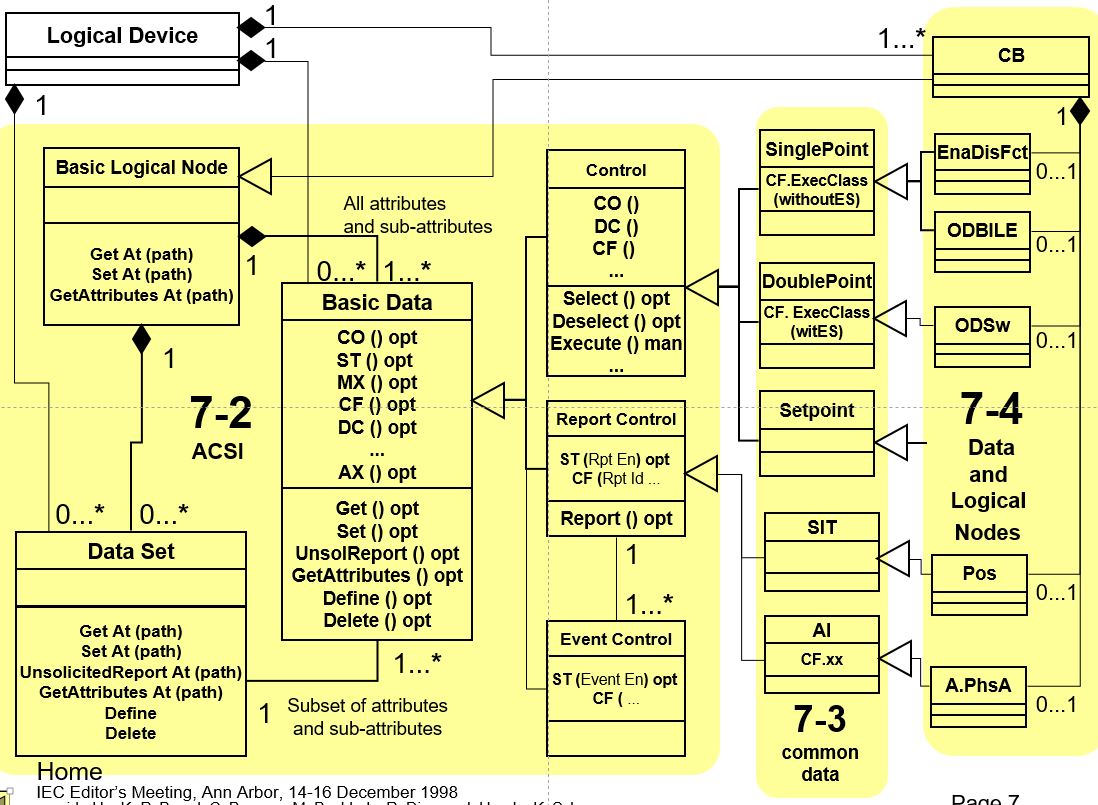
The experts involved have discussed several options how to model the signals. In December 1998 the editors of the core documents (including myself) met in Ann Arbor (MI, USA).


We discussed modelling with ASN.1 or our own notation:


we were not quite happy ... then we discussed trying UML … walked across the street to the University bookshop to purchase some 10 Books about UML Modelling. I purchased several books, too:


… a senior development manager of protection relays was strictly against UML … he said, it will never be used for protection and automation. Some weeks later I met his engineers in their office … and saw that they used UML for developments …

Later I tried OWL with some success:


Experts involved in CIM (Common Information Models) used UML - with the SPARX tool Enterprise Architect (EA). It took several years before UML (and EA) was used to define all models of IEC 61850. Today (end of 2019) almost all models and other definitions are managed with the EA - it is a big success! The latest version comprises the following parts:


There are tools available to export parts of the model from EA as Word documents, html pages, pdf ...

Example of a model:


With the application of the SPARX EA we have a single source of all crucial definitions.

Note: The EA package "IEC61850Domain" is only available for the experts writing, publishing and maintaining the various standard parts.

Some exported documents (the so-called code components) are available for free access:
Click HERE for accessing these documents.

Thanks to the experts that have continuously pushed for using UML and EA. It took several years ... and it was not easy for engineers to use a formal language and tool to get where we are today.

These days the EA is used also for many other tasks: use cases, design state machines like for IEC 61850-90-16 (System management), ... IEC TC 57 has done a good job in using UML for CIM and IEC 61850. But another generation of engineers is needed to understand the full benefit of using UML.

Monday, November 3, 2014

UCAIUG Interoperability Report (Munich 2013) available – And Now?

IEC 61850 defines Modeling Methods, Information Models, Abstract Services, Service Mapping to MMS, Configuration Language to specify a whole System composed of several substations et cetera. Some 10 years after the publication of the first edition of the core parts (3, 6, 7-1, 7-2, 7-3, 7-4, 8-1 and 9-2) we expect the edition 2.1 of the core documents early 2014. There is a lot of progress during these 10 years of applications!

The well accepted tissue process has helped to increase the consistency of the various parts of the series and to help to reach a high level of conformity of devices and tools:

www.tissues.iec61850.com

In addition to Conformance tests it is obvious that Interoperability is one of the crucial issues that is expected by the users community. Many organizations are involved to further increase the Interoperability between the products provided by many vendors. One major step towards a higher level of interoperability is the UCAIUG Interoperability Test Session that was conducted at TÜV SÜD (Munich, Germany) the week of 27. October – 01. November 2013.

Click HERE to download the 240 page Report [pdf, 5.8 MB].

One of the crucial lessons I (and many other experts) have learned trough my long-term involvement in the standardization groups and more than 200 training courses is this: In case you are planning to use the new (IEC 61850) Technology in one of your next projects:

  1. Get education and training from neutral trainers
  2. Purchase or lent the devices and tools you are about to use in the real world: protection & control devices, SCADA systems, RTUs, Network Infrastructure like Switches and Routers, and Tools … and test them as a kind of “Multivendor Interoperability Test”
  3. You can speed up this process by cooperating with FMTP Power Systems and NettedAutomation: They could come to you and provide the most well known and used devices and Tools and introduce Theory and Practice!!
    This helps to keep the cost low – you don’t need to figure out what to purchase … and how to use the Technology when you start.
    You would get the right support for a fast start … the most efficient way!

Please check these dates and locations:

Special Protection & Control Hands-On Training:
08.-10. Dec 2014 in Prague (Czech Republic)

Click HERE for the details

Special Protection & Control Hands-On Training:
16.-19. December 2014 in Guayaquil (Ecuador):

Click HERE for the details [pdf]

Common Hands-On Training in German:
24.-26. November 2014 (Karlsruhe)
12.-14. Januar 2015 (Karlsruhe)
23.-25. März 2015 (Karlsruhe)

Click HERE for more details

I look forward to meeting you there.

Wednesday, January 30, 2013

First day of DistribuTECH in San Diego

This year’s DistribuTECH exhibition seems to have a lot more booths than before. The huge hall has 34 rows full of large and small booths. When you walk the floor you see many products that provide IEC 61850 connectivity.

image

A lot of people I spoke to are in the process of developing IEC 61850 connectivity or are planning to do so in the near future.

The UCAIUG booth 1648 was visited by may people from all over:

image

The annual meeting of the UCAIUG IEC 61850 group focused on testing. The experiences show that IEC 61850 conformance tests are an absolute must for IEDs that claim to be conformant. But: The focus on testing will definitely move towards interoperability testing.

TÜV SÜD reported about their experience with testing. They are a strong supporter of interoperability testing. TÜV SÜD could play a major role in defining the needed requirements and rules and they could be a major organization to setting up test facilities.

ENTSO-E’s activity to get involved in the quality improvement process of the standard and conformant products is welcome throughout the industry.

ENTSO-E has published a Research and Development Roadmap for the next 20 … 30 years. Communication infrastructure is one of the key elements in the future power delivery system.

Download the Roadmap. [pdf, 1.7 MB]

Monday, August 27, 2012

TÜV SÜD Conformance Test Lab for IEC 61850 accredited

TÜV SÜD (Munich, Germany) has been authorized on August 24, 2012 to perform IEC 61850 Conformance Testing (for servers) in accordance with the Users Group Quality Assurance Testing Program Procedures. TÜV SÜD is a third party test lab that offers Level A tests.

Congratulation!

image

TÜV SÜD
Barthstrasse 16
80339 München / Munich
Mr. Peter Pfisterer
+49-(0)89-5791-3372
mailto:Peter.Pfisterer@tuev-sued.de

It could be expected that this new test lab will speed up the tests for IEDs with IEC 61850 server functionalities – and it is likely that the total cost for a certificate will be lower than before.

The first tests run have already helped to improve the quality of products.

Thursday, July 19, 2012

IEC 61850 conformance certificates

The UCAIUG (international UCA users group) manages the certification process for IEC 61850 conformance. With a guest login you can access the test requirement documents, authorized test labs and lists of conformance certificates.

The website shows 276 certificates for servers, 13 for clients, and 2 for merging units.

Access list of certificates of IEC 61850 conformance tested devices and other testing related documents.

Friday, February 3, 2012

Wind and Solar Gas – A Challenging Storage Option

As you know, there is a crucial challenge with renewable power generation – wind and solar power are often generated during times when it could not be transported to the load centers! Usually generation has to stop – even the wind is blowing and the sun is shining. So, how to work around?

In November 2011 there was a big conference in Berlin to discuss a new way of storing energy: the existing natural gas network may become a cornerstone for a renewable energy system that provides huge storage, transport and distribution capacities that are hundred times larger than the electric power grid.

Electrons and gas? Yes!

The “SolarFuel” power-to-gas method could convert renewable electricity into CO2 neutral, renewable natural gas.

What does it all mean:

  • More renewable electricity could be generated.
  • Renewable natural gas stores the energy for days, weeks and months due to huge capacities in the tubes used for transportation and distribution
  • Energy is accessible everywhere and at any time.

I remember that our gas utility here in Karlsruhe buried huge tubes (some 100 cm in diameter) in the 90s – this allows to transport and store more gas (volume increases to the second of the diameter). Copper wires can transport more electric power with bigger cables – but the wires do not store more electric power ;-)

The gas storage in Germany could (if full) be tapped for some 6 month!!

The new discussion is about Hybrid Grids: Electric Power, Gas and Heat. More to come soon.

One thing is for sure: We will be challenged by a steep growing demand of Information Models to be added to IEC 61850 for the many aspects of hybrid grids. UCA (the forerunner of IEC 61850) was adapted by the GRI (Gas research institute, USA) for use by gas utilities. This effort culminated in an evaluation of UCA in a gas utility environment at Pacific Gas and Electric Company, San Francisco, in the 90s.

Excerpt of logical nodes (called Bricks in UCA) from the document: Integrated UCA(TM) for Gas Industry / Volume 2: Gas Industry Device Object Models.

image

image

  • Pressure monitors for inlet, intermediate and outlet gas (PMON0, 1, 2 respectively)
  • First stage pressure regulating valves (PRVL0, PRVM0 and PRVH0 for low, mid and high range valves respectively
  • Gate station flow monitors for low, medium and high flow rates (GSFL0, GSFM0, and GSFH0 respectively)
  • Gas quality monitor (QMON0):

image

Click HERE for the list of 6 reports from GTI (former GRI) [2000]
Click HERE to get some more information on wind and solar gas.
Click HERE for a comparison of IEC 61850 and UCA [2004].

IEC 61850 logical nodes for the gas and heat application domain could easily be defined and (if needed) standardized.

Wednesday, January 4, 2012

Register of tested IEC 61850 devices

KEMA has recently published an updated Test Register (version 2011-11-28) for

  • IEC 61850 Client Systems [8 clients successfully test]
  • IEC 61850 Server Devices [total: 212 – 2011:42 / 2010:21 / 2009:34 /before:115]
  • IEC 61850 Ethernet Switches [23]
  • IEC 61850 Sampled Value Publishers (Merging Units) [2]

Click HERE for the complete list [pdf]

Click HERE for the IEC 61850 certificates; if you don’t have an UCAIUG login account you can apply for a free guest account.

Wednesday, August 18, 2010

IEC 61850 Test Labs and Certified IEDs

The UCA International Users Group (UCAIug) has approved seven
IEC 61850 Test Labs (as of 21 July 2010):

ABB Switzerland Ltd
Server: Level B

American Electric Power (AEP)
Dolan Technology/Testing Center
Client and Server: Level A

AREVA T&D UK Ltd,
Substation Automation Solutions
Server: Level B

KEMA Nederland BV
Client and Server: Level A

NARI-RELAYS Electric Co., Ltd., Nanjing, China
Server: Level B

Xuchang KETOP Electrical Apparatus
Testing & Research Institute, Henan, China
Server: Level B

Additional labs are underway.

A total of 155 certified products are listed at the UCAIUG website.

Thursday, September 3, 2009

Interoperable Standards for Smart Grid: US$ 8.5 million for two year support to get there

The Smart Grid in the U.S. (and all over!) relies on information and networking technologies to allow advanced control and communication capabilities. "It is a key component of President Obama’s plans to achieve energy independence and to address climate change.", according to NIST.

NIST has awarded EnerNex (based in Knoxville, TN, USA) to help in developing "Smart Grid interoperability standards" and helping in standards "harmonization effort". Under the US$ 8.5 million contract, EnerNex will help NIST during the next two years to reach a higher level of interoperability of systems and devices needed for a smart(er) electric power delivery system.

Many people in charge of the U.S. power delivery system - obviously - have understood the importance of a sustainable Interoperability in the utility domain.

Two crucial "interoperability projects" have been run by EPRI many years ago: UCA 1.0 and UCA 2.0. The UCA 2.0 was taken over by IEC TC 57 as the foundation of IEC 61850 and IEC 61400-25. The GREAT cooperation between the North American experts and experts from all over has let to the BIG success of UCA 2.0 - which is (of course) now IEC 61850.

Click HERE for a comparison of UCA 2.0 and IEC 61850.

I would appreciate if the history would repeat: The development of the many standards for a SMART(er) GRID will be done by international cooperation for a global market!! The need for smarter systems is an international requirement - to the good of human beings and the nature - in Russia, Germany, USA, Australia, ... Smart experts at TERNA (the Italian TSO) have already started to make the Italian Transmission Grid smarter with IEC 61850:

clip_image002

... and some 350 Indian experts have been trained on IEC 61850 in a three day event in Bangalore:

clip_image002[5]

And how are you getting involved? With the help of real experts you can speed up your knowledge in international smart grid standards very fast - ask the right experts during the upcoming IEC 61850 events in Frankfurt, San Antonio, Nürnberg, Brisbane and Sydney, ...