I guess you have heard that IEC 61850 defines a lot of Information Models. Yes, You are right.
The models are managed exclusively by the corresponding working groups with the Enterprise Architect UML Tool (the UML data base is for internal use only). The model version:
UML model of 61850 (wg10built6-wg18built3-wg17built5-jwg25built2-tc17built1-tc38built1.eap)
comprises the following number of Logical Node Classes, Data Objects (Attributes), Enumerations and Abbreviations:

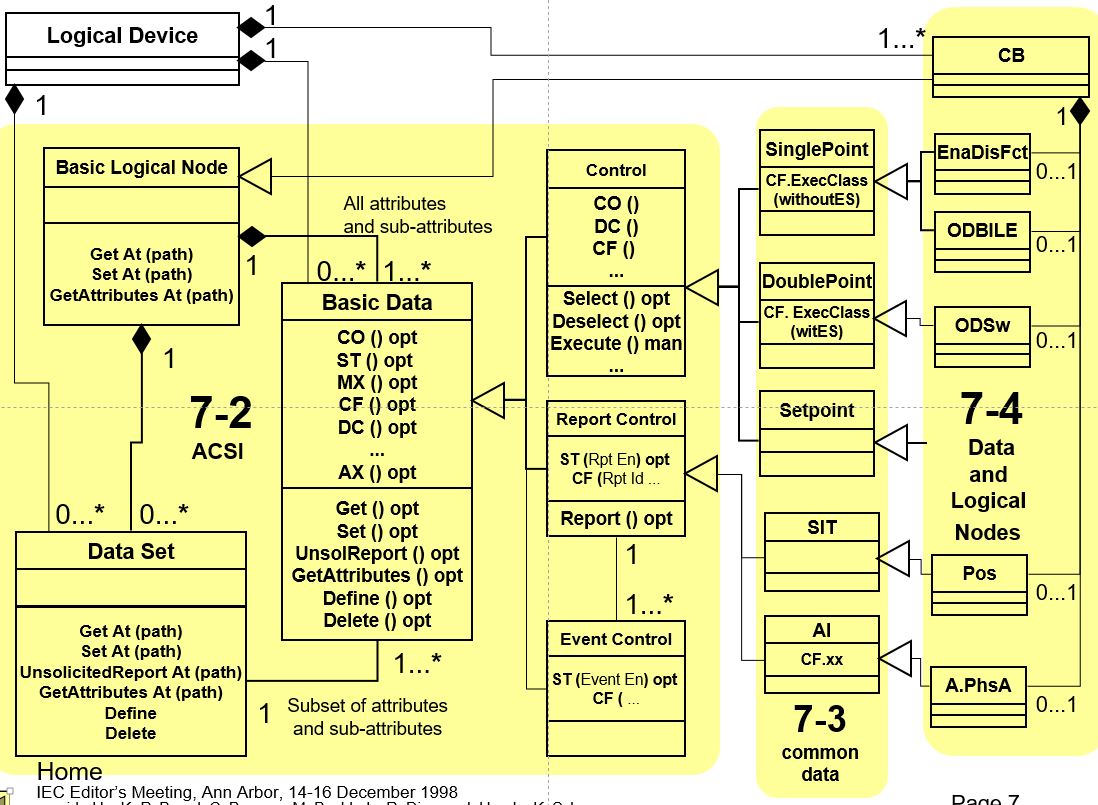
An excerpt from the UML modes looks like this:

The UML Model is the single source data base that is used for the extensions and maintenance of the model, as well as the generation of Word or PDF documents ... The PDF documents are sold by IEC and other organizations.
You may complain that the standards are not for free ... hmm ... BUT look: You can download the various Code Components for free.
Click HERE for the Code Component for IEC_61850-7-4.NSD.2007A2.light.zip (IEC 61850-7-4 2007A2 NSD light, see the IEC 61850-7-4:2010 for full legal notices). The full version has additionally the semantic descriptions of the models.
Example of Enumeration:

Example of excerpt of LN Class MMU:

Click HERE to see the list of all Code Components as per today ... more to come soon.
To my understanding you can model many required information generated and consumed by a huge number of applications in almost all application domains of automation in the electrical system and beyond.
As the above example of MMXU shows, you can use this LN Class wherever you have 3 phase AC system!! In a building heating system for the electrical values of a compressor or a fan or a pump or ... the blue sky is the limit for the applications.
Click HERE to learn about crucial details discussing the LN Class MMXU and how it can be applied ... you may have never expected this comprehensiveness of the MMXU.
Note that the 3 phase system was first (more than 100 years ago) - then we have put a facade in front of the measurement function which exposes the measurements as data objects of the class MMXU. The application has driven the class - not vice versa.
The current edition 2.1 models defined in IEC 61850-7-3 and 7-3 are listed in the contents tables of the preview documents. The following Preview documents (free access) for models of the edition 2.1 consolidated versions are available:
Preview IEC 61850-7-3 Edition 2.1
Preview IEC 61850-7-4 Edition 2.1
Example of 7-4 from the preview:

In case you find any error in the standards, please visit the Tissue Database:
https://iec61850.tissue-db.com/parts.mspx
The models are managed exclusively by the corresponding working groups with the Enterprise Architect UML Tool (the UML data base is for internal use only). The model version:
UML model of 61850 (wg10built6-wg18built3-wg17built5-jwg25built2-tc17built1-tc38built1.eap)
comprises the following number of Logical Node Classes, Data Objects (Attributes), Enumerations and Abbreviations:

An excerpt from the UML modes looks like this:

The UML Model is the single source data base that is used for the extensions and maintenance of the model, as well as the generation of Word or PDF documents ... The PDF documents are sold by IEC and other organizations.
You may complain that the standards are not for free ... hmm ... BUT look: You can download the various Code Components for free.
Click HERE for the Code Component for IEC_61850-7-4.NSD.2007A2.light.zip (IEC 61850-7-4 2007A2 NSD light, see the IEC 61850-7-4:2010 for full legal notices). The full version has additionally the semantic descriptions of the models.

Example of excerpt of LN Class MMU:

Click HERE to see the list of all Code Components as per today ... more to come soon.
To my understanding you can model many required information generated and consumed by a huge number of applications in almost all application domains of automation in the electrical system and beyond.
As the above example of MMXU shows, you can use this LN Class wherever you have 3 phase AC system!! In a building heating system for the electrical values of a compressor or a fan or a pump or ... the blue sky is the limit for the applications.
Click HERE to learn about crucial details discussing the LN Class MMXU and how it can be applied ... you may have never expected this comprehensiveness of the MMXU.
Note that the 3 phase system was first (more than 100 years ago) - then we have put a facade in front of the measurement function which exposes the measurements as data objects of the class MMXU. The application has driven the class - not vice versa.
The current edition 2.1 models defined in IEC 61850-7-3 and 7-3 are listed in the contents tables of the preview documents. The following Preview documents (free access) for models of the edition 2.1 consolidated versions are available:
Preview IEC 61850-7-3 Edition 2.1
Preview IEC 61850-7-4 Edition 2.1
Example of 7-4 from the preview:

In case you find any error in the standards, please visit the Tissue Database:
https://iec61850.tissue-db.com/parts.mspx




 Posts
Posts


