Friday, September 11, 2009

Paper on IEC 61850 and IEC 61400-25 accepted for DistribuTech 2010

The abstract "MONITORING OF POWER SYSTEM AND COMMUNICATION INFRASTRUCTURES BASED ON IEC 61850 AND IEC 61400-25" (by Karlheinz Schwarz) has been accepted for presentation at the DistribuTech 2010 (Tampa, FL, USA).

The focus of the first edition of IEC 61850 was on substation operational aspects (mainly protection and control). Various groups have identified that IEC 61850 is the basis of further applications, e.g., monitoring of functions, processes, primary equipment, and the communication infrastructure in substations and other power system application domains. The second edition and other extensions provide new definitions to keep the high quality and availability of power systems, to reduce commissioning
time and life cycle costs.

Track Assignment: Enterprise Information and Asset Management
Session Assignment: Case Studies of Advanced Applications Extending Benefits of Automation & Control Data
Date: 2010-03-24 (Wednesday)
Time of session: 9:30 AM
Type of Session: paper

Click HERE for the abstract.

Monday, September 7, 2009

Beckhoff's TwinCAT supports IEC 61850

Beckhoff opens up new opportunities by implementing this communication protocol in a software PLC: The user can use a cost-effective standard PLC for controlling his electrical installation, which not only offers the benefits of PC-based control technology but can also communicate externally via the IEC 61850 compliant communication. The basic standard defines a general transmission protocol for protective and control equipment in medium and high voltage electrical substations. This means that time-consuming and costly special developments for the implementation of manufacturer-specific protocols are no longer required, and the associated engineering is simplified significantly.
Customers can utilize the complete communication stack developed by Beckhoff in the form of a PLC library.

As extension to the basic IEC 61850 standard, IEC 61400-25 defines the communication requirements for monitoring and controlling wind turbines. The integration of this standard into the TwinCAT library will simplify the control of heterogeneous wind farms significantly. The wind farm standard is characterized by a single wind power-specific datset, so that TwinCAT users can use TcIEC61850Server.lib for communication purposes and TcIEC61400_25.lib for specific logical nodes and common data classes.

Click HERE for a two page brochure in English.
Click HERE for a two page brochure in German.

The TwinCat solution will be used during the next Hands-on Training in Frankfurt (Germany) on October 23, 2009.

Click HERE for the program of the training in Frankfurt.

SystemCorp (Perth, Australia) offers new IEC 61850 IEDs

The IEC 61850 software stack PIS-10 accommodates client and server functionality. It is portable across various software platforms. Data throughput and other Ethernet related performance criteria are inherited from the operating system.

The stack supports MMS, GOOSE, Sampled Value functionality as well as buffered and unbuffered reporting. Data sets are defined using the WebCAN Designer Studio configuration software.

Protoocol conversation from other SCADA protocols such as IEC 8750-5-10 or DNP3.0 require only the additional executable files to be downloaded and configured through WebCAN Designer Studio.

Products:

  • Portable IEC 61850 Client and Server Software Stack PIS-10
  • Fully Integrated Single Chip Solution IPC-10
  • Compact Protocol Converter CFE-40
  • Distribution Remote Terminal Unit MRU-10
  • WebCAN Substation RTU and Data Gateway
  • WebCAN Designer Studio Configuration Tool

Platforms:

  • Microsoft Windows XP, 2003/2008 and Vista
  • Ubuntu Linux (x86,x86-64)
  • Embedded Linux (ARM, Coldfire)
  • Beck @Chip SC1x3 RTOS
  • Other platforms available on request

Click HERE for a two page description [pdf].

etz-Report 34 (IEC 61850) als E-Book erhältlich

Der etz Report 34 "Offene Kommunikation nach IEC 61850 für die Schutz- und Stationsleittechnik", 2004, 159 Seiten, DIN A4 ist jetzt auch als E-Book erhältlich:

etz34-small

Click HIER, um das Vorwort zu lesen.

Click HIER für weitere Informationen zum E-Book (Inhalt, Bestellung, ...).

Saturday, September 5, 2009

IEC 61850-6 (SCL) - Final ballot on Configuration Language Edition 2

The most crucial part of the second edition of IEC 61850 "Communication networks and systems for power utility automation" -Part 6 "Configuration description language for communication in electrical substations related to IEDs" is available for final (FDIS) Ballot until November 06, 2009. This is the first part of Edition 2 that is out for Ballot.

The new edition fixes some technical issues of the first edition. Extensions are based on changes in other parts, e.g., Part 7-2 and 7-3; the engineering process, especially for configuration data exchange between system configuration tools, has been added.

Contact your national TC 57 committee for a copy if you want to do a final check of the document. The files distributed by IEC contain all xml schema files etc. needed to create and interpret SCL files.

Example SCL file from AREVA (.icd file), Edition 1 compliant.

Note that the SCL (Substation Configuration Language) would be better named: System Configuration Language. Main parts of the standard can be used for many other application domains. Any information that can be modeled with Logical Nodes and Data Objects according to IEC 61850 rules, can be used as domain specific "words". The communication of these "words" from a "sender" (Server and Publisher) to a "receiver" (Client and Subscriber) can be described in SCL. The communication may be realized with MMS (Client/Server), or GOOSE and SMV (Publisher/Subscriber).

The new "words" may be a "Fish Counter" in a hydro power plant or a "Bird Counter" in a wind turbine. SCL can describe (without any modification) that a device (Server) provides this information and that it can automatically be communicated by IEC 61850 reporting to another computer (Client) every day or be stored locally in an IEC 61850 log. The CSL file can be used to automatically configure the server and/or the client!

Thursday, September 3, 2009

Interoperable Standards for Smart Grid: US$ 8.5 million for two year support to get there

The Smart Grid in the U.S. (and all over!) relies on information and networking technologies to allow advanced control and communication capabilities. "It is a key component of President Obama’s plans to achieve energy independence and to address climate change.", according to NIST.

NIST has awarded EnerNex (based in Knoxville, TN, USA) to help in developing "Smart Grid interoperability standards" and helping in standards "harmonization effort". Under the US$ 8.5 million contract, EnerNex will help NIST during the next two years to reach a higher level of interoperability of systems and devices needed for a smart(er) electric power delivery system.

Many people in charge of the U.S. power delivery system - obviously - have understood the importance of a sustainable Interoperability in the utility domain.

Two crucial "interoperability projects" have been run by EPRI many years ago: UCA 1.0 and UCA 2.0. The UCA 2.0 was taken over by IEC TC 57 as the foundation of IEC 61850 and IEC 61400-25. The GREAT cooperation between the North American experts and experts from all over has let to the BIG success of UCA 2.0 - which is (of course) now IEC 61850.

Click HERE for a comparison of UCA 2.0 and IEC 61850.

I would appreciate if the history would repeat: The development of the many standards for a SMART(er) GRID will be done by international cooperation for a global market!! The need for smarter systems is an international requirement - to the good of human beings and the nature - in Russia, Germany, USA, Australia, ... Smart experts at TERNA (the Italian TSO) have already started to make the Italian Transmission Grid smarter with IEC 61850:

clip_image002

... and some 350 Indian experts have been trained on IEC 61850 in a three day event in Bangalore:

clip_image002[5]

And how are you getting involved? With the help of real experts you can speed up your knowledge in international smart grid standards very fast - ask the right experts during the upcoming IEC 61850 events in Frankfurt, San Antonio, Nürnberg, Brisbane and Sydney, ...

Wednesday, September 2, 2009

IEC 61850 Hands-on Training in Brisbane and Sydney (Australia) confirmed

The final program, locations, and dates for two 3 day events in Australia are now confirmed:

Brisbane (Australia): 30 November - 02 December 2009
Sydney (Australia): 02-04 December 2009

According to feedback from interested experts we have modified the program to have more practical exercises (1 1/2 days theory and 1 1/2 hands-on training with real IEDs).

Click HERE for the final program, registration form and other details [pdf].

Please note that the event in Brisbane is almost sold out. Several seats are available for the Sydney event.

We are confident, that our experience and service will meet all your expectations! You’d get first-hand, very comprehensive, vendor neutral and up-to-date knowledge, experience, and guidance; learn how to reach interoperability of devices; You'd get best advice - for the best price.

I look forward to seeing you down under later this year.

Please feel free to forward this email to any colleagues who you think might be interested in the event.

Saturday, August 29, 2009

Technical Report IEC 61850-90-1 accepted

The Draft Technical Report "Communication networks and systems for power utility automation - Part IEC 61850-90-1: Use of IEC 61850 for the communication between substations" has been positively balloted.

The Technical report will be published on Sept 15, 2009.

Click HERE for a list of applications contained in part IEC 61850-90-1.

Sunday, August 23, 2009

Vendor-independent IEC 61850 Hands-on Training at Itaipu (Brazil)

To gain vendor-independent knowledge and experience is one of the crucial steps towards the implementation of IEC 61850 based multi-vendor projects. Itaipu (Brazil) has trained their substation experts in two courses. A comprehensive seminar at Itaipu was conducted in 2007 (Christoph Brunner and Karlheinz Schwarz). The hands-on training by STRI (Ludvika, Sweden) was run onsite in Itaipu last week (brief report in Portuguese).

The interoperability of IEDs (intelligent electronic devices) from different manufacturers needs to be tested. Experts have to understand the standardized functions AND restrictions build into the IEDs. How do IEDs use the standard? What are the constraints of limited resources in an IED? What are the functions (Reverse blocking, Auto reclosing, Switching with synchrocheck, Earthfault detection, ...) that use IEC 61850 and how are they using the standard?

STRI and NettedAutomation provide comprehensive education from understanding the Standards and Training with real IEDs - You’ll get first-hand, very comprehensive, vendor neutral and up-to-date knowledge, experience, and guidance. You'll learn how to reach interoperability of devices.

Saturday, August 22, 2009

Interoperability in the context of IEC 61850

There are many efforts underway to define or extend standards that allow or support Interoperability between devices in the electric power delivery system. IEC 61850 is one of the crucial standards that is understood as to meet basic requirements.

According to the "EICTA White Paper on Standardization and Interoperability, Brussels, November, 2006 (page 4)" Interoperability is defined as follows:

“The capability of two or more networks, systems, devices, applications, or components to exchange information between them and to use the information so exchanged.”

What does this all mean for the application of IEC 61850? Currently there are some problems with the interoperability of real devices implementing one or the other option of IEC 61850. That is the challenge: Which option do the devices use that are intended to be interoperable?

We have to differentiate interoperability on different levels: physical, syntactical, services, devices, … functions. In the following we will briefly focus on services and devices [Note: This discussion just points to the general issue of options; details on interoperability issues are presented and discussed during the seminars of NettedAutomation GmbH (Karlsruhe/Germany)].

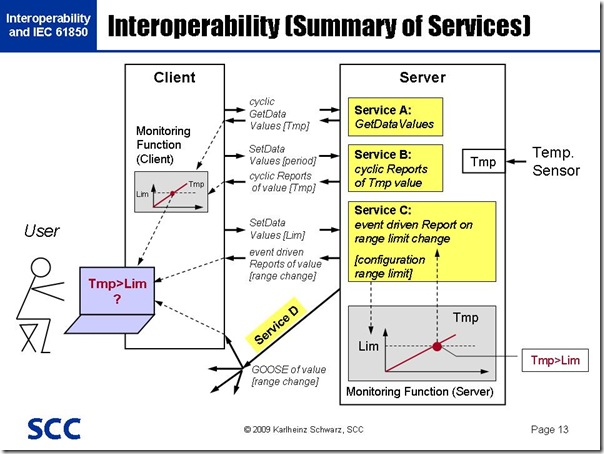
The following slide summarizes some option of what Interoperability could mean for a simple use case. The Purpose of the use case is:
Monitor the Temperature (Tmp) and figure out when the Tmp exceeds the Limit (Lim). There are two devices involved (Client and Server). Depending on the functional distribution of the monitoring function (located in the client or in the server) we can use one or the other Service of IEC 61850. In the case of Services A and B we assume that the purpose is to implement the monitoring function in the client. In the other two cases (C and D) we assume that the monitoring function is provided by the device that acts as server.
Interoperaility_2009-08-20

The four services (associated with the functional distribution) are quite different. Once the "user" (usually the system integrator) of the client and  the "user" of the server HAVE DECIDED WHICH APPROACH (A, B, C, or D) to use then we could talk about interoperability. IEC 61850 DOES NOT constrain which approach to use. IEC 61850 is scalable - that means YOU HAVE TO make decisions how to scale! Which option to use!

The IEC 61850 services do not constrain the behavior of an IEC 61850 client application process, except with respect to valid sequences of service primitives. Therefore a model of the IEC 61850 client application process is not (!) provided in the current standard.

If the two "users" decide to use the option with Service A then we could define, what is required to make the client and server interoperable. This is defined in IEC 61850 for all approaches shown in the figure.

Challenges with regard to interoperability are here: The "users" of both devices DO NOT define the exact approach (to use an approach with Service A or B, C,or D). Just to expect that the vendors have implemented ALL approaches is dangerous: Usually the vendors implement the mandatory (M) requirements - which could also be translated to M=Minimum! Two devices conformant with IEC 61850(with a Certificate) may or may not interoperate! Depending on the functional distribution and the services provided and used.

Non-Interoperability could have many reasons:

1. Client and server might implement only a subset of the full specification. In some cases, there may be a mismatch in what features are supported, where one system sends a message that the other cannot process.

2. The IEC 61850 specification makes certain things optional. If one implementation assumes that specific information will exist on messages it receives, it may not interoperate with another implementation that chooses not to send that information.

3. Two implementers may interpret parts of the standard, where the language of the specification is ambiguous.

4. Finally, implementers may simply have bugs in their implementation that that do not show up during standalone testing. Such bugs may also contribute to interoperability problems when two different implementations attempt to hook together.

To make devices interoperable requires (among other requirements) that the "users" of two devices specify exactly the distribution of the (application) functionality and which service to use for that functionality!

This specification (and the discussion of the involved people) is mainly outside of the standardization work. Some hints on the modeling approach (not that much on the use of services) will be given in new documents to be published by IEC, e.g., IEC 61850-7-510: Hydroelectric power plants – Modeling concepts and guidelines. This Technical Report is intended to provide explanations on how to use the Logical Nodes defined in IEC 61850-7-410 as well as other documents in the IEC 61850 series to model complex control functions in power plants.

Example of working draft of IEC 61850-7-510 (2009-08) - Excitation function:

image

The document will provide general use cases of the models defined in IEV 61850-7-410.

Sustainable Interoperability of devices is a crucial challenge in the domain of Power Automation systems.

Tuesday, August 18, 2009

Revised Input to NIST Interoperability Roadmap available

The input from EPRI to NIST was out for public review until end of July 2009. The team has received 83 comments that have been used to revise the EPRI input to NIST.

Many IEC Standards are referenced in the document: IEC 61968/70 (CIM), IEC 61850, IEC 61400-25, IEC 61499, ...

Click HERE to download the Report to NIST on the Smart Grid Interoperability Standards Roadmap After Comments were addressed [pdf].

Click HERE to download the Consolidated Comments August 10, 2009 [pdf].

Click HERE to check results of the Workshop, August 3-4, 2009.

Click HERE to check the latest Priority Action Plans (PAPs) that has been updated on August 10; after the August 3-4, 2009, Workshop.

Friday, August 14, 2009

IEC 61131-3 SPS-Programmierung und IEC 61850

Zunehmend findet IEC 61850 Eingang in die Welt der Steuerungen. Neben anderen namhaften deutschen Herstellern hat jetzt auch WAGO (Minden) einen IEC-61850-Server in die Steuerungssoftware integriert.

Aufbauend auf der Codesys Version 3 bietet WAGO eine IEC-61850-Bibliothek an, mit der die Vorteile der Objektorientierung unter Verwendung der Objektmodelle der Normenreihe IEC 61850 und IEC 61400-25 genutzt werden können.

Click HIER für eine einseitige Einführung in IEC 61850 und IEC 61400-25 [pdf]

Click HIER für einen weiterführenden Artikel zur WAGO-Lösung im Heft 8-2009 der Zeitschrift Computer & Automation.

Im Artikel wird noch davon ausgegangen, dass IEC 61850 nur eine Abbildung der Objekte und Kommunikation unterstützt: MMS (Manufacturing Message Specification, ISO 9506). Seit einem Jahr gibt es eine internationale Norm mit weiteren Abbildungen: IEC 61400-25-4:

IEC 61400-25 umfasst die folgenden fünf Abbildungen:

  • SOAP-based web services,
  • a mapping to OPC/XML-DA,
  • a mapping to MMS (IEC 61850-8-1),
  • a mapping to IEC 60870-5-104,
  • a mapping to DNP3.

Click HIER für weitere Details zu den Mappings (Abbildungen).

Unter dem Titel "IEC 61850 - Die universale Norm für die Informations-Integration" wird am Dienstag, 24.11.2009, 14:00 - 17:00 Uhr, während der SPS/IPC/Drives in Nürnberg ein Tutorial durchgeführt; Vortragssprache ist Deutsch.

IEC 61850 Hands-on Training in Australia (December 2009)

IEC 61850 is the global standard for Power System Automation (generation, transport, distribution ... high, medium and low voltage levels). It allows for an open and “future proof” design, different architectures and possibilities to combine products from multiple vendors. In order for users and system integrators to utilize the benefits of IEC 61850 it is necessary for power utilities, integrators and vendors to educate their most crucial asset – People; and to start the migration to IEC 61850.

The popular STRI and NettedAutomation hands-on training provides both theory and practice on the application of IEC 61850 in a substation. During the training we follow the planning, design and engineering process for real applications all the way to configuration and testing on a real multivendor test installation. We believe real understanding is the result of both knowledge and hands-on experience. Therefore the training offers a unique combination of presentations, demonstrations and practical workshops in smaller groups.

Many utility experts have been trained, as TERNA (Italy):

clip_image002

The interest in performing such an event in Australia is high. We are right now negotiating with some utilities to fix the content, dates and locations.

Tentative locations and dates for 3 day events:

Brisbane (Australia): 30 November - 02 December 2009
Sydney (Australia): 02-04 December 2009

Click HERE for the tentative program and other details [pdf].

By end of August 2009 it is expected to announce the final contents, locations and dates.

Updated FERC Smart Grid Policy and Interoperability

The US Federal Energy Regulators Commission (FERC) has published recently an updated Smart Grid Policy (Docket No. PL09-4-000, Issued July 16, 2009).

Excerpt from the summary of the report: "This Policy Statement provides guidance regarding the development of a smart grid for the nation’s electric transmission system, focusing on the development of key standards to achieve interoperability and functionality of smart grid systems and devices. In response to the need for urgent action on potential challenges to the bulk-power system, in this Policy Statement the Commission provides additional guidance on standards to help to realize a smart grid. ...".

The essential term used is "Interoperability" (Interoperability is described as exchanging meaningful information between two or more systems and achieving an agreed expectation for the response to the information exchange while maintaining reliability, accuracy, and security; according to GridWise). The term "Interoperability" is used 89 times throughout the policy statement.

One of the crucial standards that supports interoperability in power system automation, protection and control is the standard IEC 61850 ... also referred to in the policy statement: "The Commission stated that IEC Standards 61970 and 61968 (together, Common Information Model), along with IEC 61850 (Communications Networks and Systems in Substations), could provide a basis for addressing this issue."

Interoperability is impacted by many aspects (standard definition, implementation, subsetting, resources available in a device, ...). Two IEDs that are fully compliant may not be able to talk together, because of resource restrictions. A Server IED may support 3 TCP connections. A fourth client that wants to retrieve some information from that server cannot even open a TCP connection - due to the resource restriction. From an application point of view the two devices cannot interoperate.

There is a crucial difference in the use of TCP for general web applications and IEC 61850 (and other close to real-time applications). Usually a client opens a TCP connection posts a request, gets some responses, and closes the TCP connection.  Web browsers, in their simplest mode of operation, would just connect to download a page and then disconnect. This simple transactions use very little resources. The resources are free after each transaction. But connecting and disconnecting repeatedly to the same server does carry an overhead and slows the communication down.

To allow close to real-time information exchange over TCP requires to keep the connection open all time. This has the drawback that the server needs to reserve resources for each client - independent if there is little or high traffic. For that reason IEDs in power systems (often with very limited resources) have a limited number of clients that can communicate with them at the same time. Once resources are consumed, there is no interoperation with one additional client possible at all.

This kind of limited resources in automation devices makes interoperability a challenge. If two devices do not operate: please do not start to blame it to the standard or to the implementation ... A system integrator needs to know many details on limitations. Be aware: Everything is limited!

The discussed challenge is independent of the upper layer protocols like DNP3, IEC 60870-5, IEC 60870-6, IEC 61850, ... it is typical for all protocols in the automation domain that use TCP.

Click HERE for the complete FERC Smart Grid Policy.

Wednesday, August 12, 2009

Webservices for IEC 61850 or IEC 61850 LE (Lite Edition) are here

From time to time there is a discussion on the protocol stack for IEC 61850 - which is based on TCP/IP, upper OSI layers and MMS (ISO 9506). Some people today are looking for a lite edition that may use DNP3, IEC 60870-5-10x, or even Webservices.

Is there a need to define these protocol stacks during the years to come? NO!! The Standard IEC 61400-25-4 defines these stacks (published 12 months ago, 2008-08). No, I am not kidding. The Standard has been published by IEC TC 88 (Wind Turbines):

Wind turbines – IEC 61400-25-4: Communications for monitoring and control of wind power plants – Mapping to communication profile

Click HERE for the preview of the standard.

The stacks specified in this part of IEC 61400-25 comprise:

  • SOAP-based web services,
  • a mapping to OPC/XML-DA,
  • a mapping to MMS (IEC 61850-8-1),
  • a mapping to IEC 60870-5-104,
  • a mapping to DNP3.

All mappings are optional, but at least one optional mapping shall be selected in order to be compliant with this part of IEC 61400-25.

The stacks in IEC 61400-25-4 are covering all or parts of the abstract services in IEC 61400-25-3 (IEC 61850-7-2, ACSI) - excerpt of the list of mappings and services supported:

image

Example of a service for the Webservice stack (excerpt):

image

The mapping of services to DNP3 is depicted for one example (excerpt):

image

The mapping of Common Data Classes to DNP3 is depicted for one example (excerpt):

image

So: Why waiting for an IEC 61850 LE or for IEC 61850 Webservices - Here they are: IEC 61400-25-4.

If there is a need to revise or improve the stacks, visit the Tissue Data Base for IEC 61400-25.

You are experienced with IEC 61850? - Looking for a new job in the U.S.?

The Public Service Company of New Mexico (USA) is looking for an engineer with experiences in IEC 61850.

The job description asks for: "... Provide direction to improve the reliability of subtransmission and transmission electrical facilities, and design of electrical substation automation under IEC 61850. ... and experience working with large consulting firms in the power industry and large industrial users, and must also have experience with or have researched IEC 61850 substation automation.

Click HERE for the full text of the job description.

Tuesday, August 11, 2009

COPALP supports IEC 61850

The French company COPALP (focused on IEC 61131-3 based provide software tools and components for embedded systems) has integrated the Standard IEC 61850 into their architecture.

According to COPALP: "The Energy and Water industries require more and more complex protocols and control applications to meet the growing demands for more information, more often. ... The IEC 61850 is one new component to the COPALP offer that comes in addition to the existing one like IEC60870-101 slave, IEC60870-104 server and DNP3 slave protocols."

Click HERE for their full news release.

The next step after IEC 61131-3 will be IEC 61499 (Function Blocks) with IEC 61850 information exchange.

NIST reports progress in transforming the power grid into a Smart Grid

The other day George W. Arnold (National Coordinator For Smart Grid Interoperability) reported to the House Committee on Science and Technology Subcommittee on Energy and Environment United States House of Representatives on the progress in transforming the U.S. power grid into a Smart Grid.

Mr. Arnold reported that "Modernizing and digitizing the nation’s electrical power grid—the largest interconnected machine on Earth—is an enormous challenge and a tremendous opportunity. Success requires a combination of quick action and sustained progress in implementing and integrating the components, systems, and networks that will make up the Smart Grid. ... it is important that we base our standards, wherever possible, on international standards or work to get our approaches adopted as international standards. This will maximize the opportunities for U.S. suppliers to address a large, global market opportunity. Fortunately, we are well-connected to International Electrotechnical Commission (IEC), IEEE and other international organizations and are pursuing those connections vigorously in our effort. ... it is essential that we base the Smart Grid on open standards."

Click HERE for the full (10 page) Testimony.

NettedAutomation GmbH (Karlsruhe/Germany) believes that the Net(works) will automate the future power generation, transmission, distribution and power consumption: The Net is the Automation. 

The driving force behind the standardization is to effectively and efficiently perform seamless device data integration and sharing information based on a rich, fine-grained data-stream about the state of the “power world” in any given instant. Every node in the network would have to be awake, responsive, flexible, and – most important – interconnected with everything else: A distributed energy web.
(from "Seamless Communication with IEC 61850 for Distributed Power Generation" by Karlheinz Schwarz, SCC, Karlsruhe, Germany)

Click HERE for a copy of the full paper on Seamless Communication with IEC 61850 for Distributed Power Generation presented at the 2002 DistribuTech in Miami (FL).