Sunday, June 29, 2014

One Standard – multiple Terms for the same Thing

The Standard series IEC 61850 and IEC 61400-25 define hundreds of new terms for information models and communication models. Usually a term defined in one part and re-used in another part is the same (syntactically and semantically). In some cases you will find different terms for the same “meaning”.

Here is one example to explain what I mean:

The Standard part IEC 61850-7-2 (ACSI) defines in clause 12.3.3.3:

TrgOp [0..2] – trigger option

The attribute TrgOp of type TriggerConditions shall define the trigger conditions (associated to a data attribute of a data object) that may cause a report to be sent or a log entry to be stored into a log.

Three values are defined to be used inside the data object:

dchg data-change A report or a log entry shall be generated due to a change of the value of the associated data attribute

qchg quality-change A report or a log entry shall be generated due to a change of the value of the associated quality data attribute q

dupd data value update A report or a log entry shall be generated due to updating the value of a data attribute. An updated value may have the same value as the old
value. An example is freezing the value of a freezable data attribute updating the value of another data attribute, which could lead to the same value it already has.

The trigger conditions integrity and general-interrogation of the TriggerConditions type are used independent of instances of a data object.

The service parameter IntegrityPeriod is mapped to intgPd:

17.2.2.12 IntgPdintegrity period

IntgPd shall indicate the period in milliseconds used for generating an integrity report.

So far so good – even we have already three terms:

integrity, IntegrityPeriod, IntgPd, or integrity period.

What does part 6 (SCL) define?

<xs:complexType name="tTrgOps">
   …
   <xs:attribute name="period" type="xs:boolean" use="optional" default="false"/>

and for the value attribute of “period”: intgPd="2000" in the report configuration element.

So, we find six terms that mean more or less the same thing … you have to understand what they mean and when to use one or the other!

When it comes to IED Configuration Tools (ICT), you may have to learn new terms again:

image

Here the SCL attribute “period” is set to true, if the checkbox for “Included in Integrity/Poll” is set.

By the way, these terms describe something quite easy: Push all (!) values of a DataSet every n milliseconds. Without a request from the client. In addition to the cyclic push you may configure the server to report the value of a single signal after it has changed (data change)):

image

You want to learn how to use the standard? We offer training courses that help you to apply the standards in your daily business! It is more convenient to attend a training than to read all the standards … we have the long-term experience that we would like to share with you.

Friday, June 27, 2014

Version 2 of SystemCorp’s IEC 61850 Stack and API available

The V2.02 of SystemCORP's IEC 61850 library is now available for all platforms. A new demo and evaluation package that runs under Windows is also available. This evaluation provides the DLL (includes Stack, internal IED SCL configuration tool, and API), a server application, and a client application. The demo applications come also with source code in C/C++:

image

This version supports both Edition 1 and Edition 2 of the IEC 61850 standard, and includes multiple improvements to system communication and memory management.

The following list shows the communication service models implemented:

image

and these are the API functions:

image

The API is very convenient and simple!

Click HERE for more general details.
Click HERE for the getting started check list …

We are offering 6 hours comprehensive hands-on training in our standard public training courses like the one scheduled for October 15-17, 2014:

http://nettedautomation.com/seminars/uca/sem.html#fra14-05 

The most efficient education are offered as in-house training courses.

Tuesday, June 10, 2014

Useful Links for Visitors of the SG Paris 2014 - From Smart Grids to Smart Networks, June 11-13

In order to save paper copies, please find links to some interesting documents I usually distribute during conferences and exhibitions:

"The Beautiful Simplicity of the Integration of Modbus, DNP3, IEC 60870-5-104, and IEC 61850 into a powerful WEB-PLC operating on an Embedded Controller"
com-tom-Gateway_Introduction_2014-03-21.pdf

com.tom WEB-PLC and Integration of IEC 61850 and IEC 60870-5-104 - This document explains the first steps
com.tom_WEB-PLC_61850-104_GettingStarted_V01.pdf

"Easy, Affordable and Fast Integration of IEC 61850 in Small Devices". - More about IEC 61850 on IPC@CHIP®.
IEC61850_Schwarz_EN_2014-03-21.pdf

Personal experience, capabilities, of Karlheinz Schwarz ... introduction on IEC 61850, training modules, feedback from attendees, list of companies, countries, and pictures

Training opportunity 15-17 October 2014 in Frankfurt/Main, Germany

Friday, June 6, 2014

A REFRESHER ON THE “STANDARDS CONTINUUM”

Erich Gunther, Aaron Snyder and Grant Gilchrist, EnerNex have published an interesting article in the SGIP Newsletter, Volume 6, June 2014 Issue:

A REFRESHER ON THE “STANDARDS CONTINUUM”

Their Conclusion is right:

“Often misapplied, the term “standard” is truly only applicable in certain situations. The author of this piece advocates reserving the use of “standard” for de jure standards, especially when employed without the "de jure" modifier. There may appear to be little harm in referring to de facto "standards" simply as “standards,” but this actually dilutes and confuses the definition in the manner that the term "engineer" is often misapplied to functions requiring no engineering education or certification. For example, in these cases, it is preferable to use the applicable term of "specification," "requirements" and "requirements specification" instead of "standard."”

Click HERE for the full article.

So far so good. There are other languages that differentiate between “Standard” and “Norm”, like in German. German “DIN Standards” are specifications that are reflecting a document that has been published with lower hurdles than a “Norm”. The “DIN Norm” compares to the de-jure Standard.

The reality is more complex than just to differentiate between de-jure Standards and other documents. The (de-jure) Standards have to be extended in many cases by non-de-jure Standards: e.g., Implementation agreements that can be written by a Two-party (two vendors, one vendor and one user, one vendor and one testlab, …), an Alliance, Users Group, or standardization bodies.

The future power delivery systems will need many combinations of de-jure (Base) Standards and non-de-jure Documents (Implementation agreements, Profiles, … and even Green-Tissues-List as in case of IEC 61850, IEC 61400-25 – these are documents that are refer to de-jure Standards).

In the end of the day, we want to get interoperable devices to build multi-vendor automation systems for the future power delivery system! Or?

In case of IEC 61850 I see a lot of pressure to come up with more “official” Implementation agreements or Profiles that are agreed by more than two parties, two companies, or two experts.

One good example is the VHPReady Industrieforum.
Click HERE for the current Specification 3.0 in English.

This is a good starting point – it’s not yet the final result … to expected early 2015.

Wednesday, June 4, 2014

MegaWatt Needs Smarter Megabit/s

What do we need? Huge countries need many MWatt (unit of power) to survive. To get the power whenever we want to use it, we need more “Smart Mbit/s” (“smart” data transfer rate in Mega bit per second). That means: more communicating devices … maybe tens of Millions in some time down the road. What do 1,000 MegaWatt (= 1 GW) and 1,000 Mbit/s (= 1 Gbit/s) have in common? These are huge numbers! And more: We need them both in the near future! The crucial issue is here: One needs the other. Zero GW means Zero Gbit/s and Zero Gbit/s means Zero GW.

Yes, you got it! The two are becoming increasingly interdependent!

There is (mainly) ONE medium to carry power: wires. There are hundreds or even thousands of media to communicate information! Guess you could not count them all. In order to keep the cost for the future power delivery system reasonably low, we could and should think of preventing the proliferation of communication systems. Guess you agree. But: Which solutions are worth to use? No doubt: IEC 61850, IEC 60870-5-104, DNP3, Modbus, … are those that would do a good job!

I would be very happy to have as many communication systems as we have power delivery systems: DC 24V, DC 48V, 3 phase AC 110V/60Hz, 3 phase AC 240V/50 Hz, … and a few more.

Clark Gellings (one of the world’s leading experts on the electricity system, ERPI Palo Alto) talked in a podcast about “The Future of the Power Grid”. He talks about crucial aspects of the future power systems. Key issues (from my point of view) are summarized in the following three points:

Question:
“So what are a few of the things that will have to happen between now and 50 years from now to make your vision of the grid a reality?

Clark Gellings’ answer:
Well, first, we’re going to need communications standards that allow devices to talk to one another, so that we don’t have the problem we have now. For example, in buildings, the electronics that are being used have as many as 28 different communications architectures. And so one building technology that might control some new thermal storage unit you have may not be able to talk to another device in that building.

Number two, the computer system that would control these millions of nodes in any given region of the United States, they don’t exist. I mean, we can control tens of thousands of nodes, and we do now, but we’re going to need to control millions of nodes. So that’s another area of development.

And thirdly, technology. For example, power electronics to fully be able to control, in a very fluid way, the power systems, even to the point of doing things like having the system self-heal, or taking action so as to mitigate from an outage that it sees, even before necessarily the outage has occurred.”

… sounds very expensive!? Not that much … listen to Clark Gellings.

Click HERE to listen to the podcast, find a link to download the mp3, and read the content.

Anyway, the 28 different communication architectures in the building automation he mentions are not so bad - compared to the factory automation with hundreds of solutions!

image

why not use the IEC 61158 (solutions)? Because it has too many!

image

IEC 61850 is about to unify most of them (at least at the near-process level where we find the Millions of signals to be shared between Millions of smart devices). And to provide smarter mechanisms to share information.

I hope we can convert more Mbit/s into “Smart Mbit/s”: using them in a smart way. Using smart communication mechanisms (like IEC 61850) will require less bandwidth and smart power systems will need less MW.

Friday, May 30, 2014

Exhibition in Paris: SG Paris 2014 - From Smart Grids to Smart Networks, June 11-13

You are invited to stop at booth i4 at the SG Paris 2014 - From Smart Grids to Smart Networks, and see IEC 61850, IEC 60870-5-104 and Gateways in action:

com.tom -Smart Grid solution

The Exhibition & Conference start from June 11 to 13 in La Défense (Paris) – daily from 8:30h – 19:00h).

In France, Smart Grid technologies have been rapidly developing over the course of the past few years, with high stakes surrounding the roll-out of smart meters, and notably ERDF's highly publicized meter, Linky, and GRDF's Gazpar.

The Smart Grids Paris trade show is now one of Europe's leading events in the Smart Grids field, counting 3000 attendees, 70 exhibitors and almost 150 speakers.

Beck IPC, EBDS and NettedAutomation invite you to visit us at the SG Paris 2014 at the booth of EBDS (European Business Development Services) i4 and see our standard-based solutions for smart grids:

  • com.tom data manager with an integrated service router, switching functionality, various modems, and live data connection to the com.tom internet portal system.
  • IEC 61850, IEC 61400-25, IEC 60870-5-104, and IEC 62351 (security) are integrated to easily build gateways and manage your data.
  • Everything you are looking for - integrated in a single device!
  • Applications: Data Concentrator, System Monitoring, Asset Monitoring, Gateway, RTU, Interface to any process level devices, sensors and actuators, …
  • Examples of applications:

Access to the exhibition is free.

More about com.tom under www.com-tom.de
More about the fair under www.sgparis.fr

See you there.

Thursday, May 22, 2014

VHPReady Website online

Das Industrieforum VHPready e.V. setzt sich für die Realisierung der Energiewende durch die standardisierte Vernetzung dezentraler Energieanlagen ein. Das Industrieforum VHPready e.V. leistet einen Beitrag zur Integration erneuerbarer Energien in den Energiemarkt und ermöglicht den Ausgleich ihrer Volatilitäten durch das orchestrierte Zusammenwirken dezentraler Energieanlagen. Der Standard VHPready und seine Zertifizierung gewährleisten das nahtlose, sichere und kostengünstige Zusammenwirken aller steuerbaren Komponenten und deren Kompatibilität und bilden die Grundlage für flexible Aggregationen dezentraler Energieanlagen zu virtuellen Kraftwerken.

Das Industrieforum hat seit einigen Tagen einen eigenen Webauftritt:

http://vhpready.de/

Click HERE for some discussion of the approach.

Thursday, May 15, 2014

IEC 61850-90-2 for the Communication With Control Centers

The Communication With Control Centers (from substations, power generation stations, and other sites) is usually based on IEC 60870-5-101/-104 or DNP3. The new part IEC 61850-90-2 will describe how IEC 61850 can be used for the above needs.

Experts from ERDF, Siemens, Solvay and RTE have published a paper that describes requirements, concepts and practical experiences related to the communication with control centers:

“Substation to control centre communication based on IEC 61850: requirements, concepts and practical experiences” (Cigre 2012)

SUMMARY
”Featuring object-oriented data models and a standardized configuration language, IEC 61850 represents the state-of-the-art communication standard for substation automation systems. On the other hand, the control centres increasingly promote object-oriented data models and standardized interfaces for data exchange based on IEC 61968 / IEC 61970 (CIM – Common Information Model). For the interconnection of substations and control centres the use of generic signal-oriented communication protocols i.e. IEC 60870-5-101/-104 or DNP3 is still current practice. In order to overcome the limitations of those legacy protocols in terms of data conversions, elaborated data exchanges and proprietary configurations and to foster the use of a seamless object-oriented communication, IEC TC57 is extending the current IEC 61850 specification to close the gap between substations and control centres. The paper gives an introduction into the topic, presents the relevant use cases and derived
requirements. Furthermore it discusses communication and modeling aspects in regards of the use case specific requirements. These concepts are evaluated against industrial power system operator needs. Foreseen consequences for standardization and practical realization of projects are identified.”

The report concludes:

The experience from projects and systems in operation have proven the benefits of IEC 61850 substation to control centre communication.”

Click HERE for the full paper [pdf]

The Canadian Smart Grid Standards Roadmap and IEC 61850

“The Canadian Smart Grid Standards Roadmap” is a remarkable document that focuses on the real needs for the future of Smart Grid Technologies and standards.

It is no surprise that IEC 61850 is a key standard in this roadmap. The roadmap comes with a list of 17 recommendations on what to do in the future. Two of the six recommendations for Transmission and Distribution (T&D) systems refer to IEC 61850:

Recommendation T&D3:
To support Smart Grid interoperability requirements, the CNC/IEC should encourage the
adoption and application of IEC 61850 for the purpose of communications between
substations
, between substations and control centre, and for transferring synchrophasor data.

Recommendation T&D4:
The CNC/IEC should encourage the development of guidelines and standards for utilities to
migrate from existing, commonly used technologies, to the architecture described in IEC
61850. At the same time, the CNC/IEC should recognize that the large, existing investment
by utilities in the older technologies will require gateway solutions and protocol converters
during the initial transition period.
• In addition, the CNC/IEC should encourage extending this standard to distribution
automation equipment and distributed energy resources
.

Other IEC TC 57 Standards are listed as well: IEC 62357, IEC 61970 and 61968 (CIM), IEC 62351 (Security), as well as IEEE 1815 (DNP3).

Click HERE for the full Roadmap [pdf, 0.9 MB].

Tuesday, May 13, 2014

Want to see IEC 61850 in action? Attend the next Free Workshop

Beck IPC offers two Free of Charge Workshops end of May 2014 in German and in English.

The interest in applying IEC 60870-5-104, DNP3, IEC 61850, IEC 61400-25 … using products of Beck IPC is growing skyrocketing!

The third free of charge Workshop in German is scheduled for:

Datum: 27. Mai 2014
Ort: Wetzlar, etwa 70 km nördlich von Frankfurt
Zeit: 10:00 Uhr - 17:00 Uhr
Programm und Anmeldung (Deutsch).

the second free of charge Workshop in English is scheduled for:

Date: 28. May 2014
Location: Wetzlar (Germany), some 70 km north of Frankfurt
Time: 10:00 h - 17:00 h
Program and registration (English).

Registration information for both events can be found under the above links.

Karlheinz Schwarz (NettedAutomation GmbH) will conduct the workshop. You will learn a lot about the Standards and the many possibilities to apply the various com.tom platforms.

The attendees of the former workshops have appreciated the deep inside view in the standards and how they can be used.

See you there.

Process Data exchange – IEC 61850, DNP3, IEC 60870-5-104, and Portal Solution

The discussion about communication mechanisms and how to get access to the most crucial information is going on. It seems to be clear that there are different requirements for different applications that need to exchange information with a specific IED (at any hierarchy level). There is not a single size that fits all. Modern IEDs will support multiple protocols to support various needs.

One mechanism is using a cloud server – often called a Portal. A simple and beautiful solution is provided by the com.tom (communication to machines) IEDs offered by Beck IPC:

image

See: http://com-tom.de/about.php 

The com.tom IEDs are supporting multiple protocols like IEC 61850, IEC 60870-5-104, Modbus, DNP3, … and a Portal. See the following figure for some details (it shows the web browser connected to the web server at the com.tom):

image

The Input and Output signals (including those configured with IEC 61850!!) will automatically be made available at the Portal as soon as the com.tom is online (trough a router: by Ethernet, WiFi, GPRS, UMTS, …):

image

The Logical Device “PQSrvLDPQ” is visible in the Web Browser (first figure), on the Portal (second figure), in the IEDScout (see next figure), and in IEC 60870-5-104 (last figure):

image

The values are also accessible through IEC 60870-5-104 through a binding of the process values (coming trough Modbus) to 104 messages (configured by the WEB PLC on the com.tom):

image

The different possibilities serve various needs.

It is quite interesting to see such a simple IED supporting these many possibilities – even supporting security (openVPN, firewall, …).

More to come.

Progress in using IEC 61850 in California and all over

Some 12 years ago I have presented a paper “Seamless Communication with IEC 61850 for Distributed Power Generation” at the DistribuTech 2002 in Miami (FL):

“… The driving force behind the standardization is to effectively and efficiently perform seamless device data integration and sharing information based on a rich, fine-grained data-stream about the state of the “power world” in any given instant. Every node in the network would have to be awake, responsive, flexible, and – most important – interconnected with everything else: A distributed energy web. … It is not sufficient to develop distributed generation systems that only produce electric power. …”

Click HERE for a copy of the full paper on “Seamless Communication with IEC 61850 for Distributed Power Generation” presented at the 2002 DistribuTech in Miami (FL).

Now, just a few (12) years later you could see this vision to become a reality, e.g., in California and other places all over.

Crucial needs and suggested solutions (IEC 61850, DNP3, …) discussed in the USA and especially in California are documented in the following interesting papers:

Click HERE for the SGIP Paper: “Distributed Energy Management (DER): Advanced Power System Management Functions and Information Exchanges for Inverter-based DER Devices, Modelled in IEC 61850-90-7” [pdf, 1.1 MB]

Click HERE for the paper “CEC/CPUC Smart DER Information and Communication Technologies (ICT) Strategies and Alternative Configurations” [Word, 1.7 MB]

Click HERE for the paper: “CEC/CPUC Candidate DER Capabilities: Recommendations for Updating Technical Requirements in Rule 21” [pdf, 1.2 MB]

It is interesting that the third paper refers to German experiences with distributed power systems: “ … For instance, most of the smaller DER systems could be pre-set with default values that may not need to change for many years. However, if the settings need to be updated, or new functions should be activate, or other communication capabilities are necessary, the utilities would not have to replace DER systems (as has occurred in Germany).
For this reason, the preferred approach to Rule 21 is that key DER functions, default settings for those functions, and basic communications technologies would be mandated but not necessarily activated. “

Web Services for IEC 61850: MMS/XER over XMPP?

Some 18 months ago I have reported on a standardization project within IEC TC 57 defining web services as a second SCSM (Specific Communication Service Mapping) for IEC 61850. In the meantime it seems very likely that a mapping to XMPP (Extensible Messaging and Presence Protocol) will be used as the only mapping in the future IEC 61850-8-2.

The secretary of IEC TC 57 has presented a slide (slide 5) with the following requirements during a public event at the Hannover Messe 2014:

  • “Part 8-2 Specific communication service mapping (SCSM) – Mappings to web protocols
  • Comply with the new edition of IEC 61850-7-1, IEC 61850-7-2, IEC 61850-7-3, and IEC 61850-7-4
  • Support the existing application data model defined in IEC 61850-7-410, 7-420 and 61400-25-2
  • Identify which web services specification should be considered to deploy cyber-security, in conjunction with IEC TC 57 WG 15 work
  • complementary to the existing SCSM (8-1), not competing”

He reported on the status of work: “Konsens bei XMPP als Lösung” (consensus to apply XMPP as solution).

Click HERE for the complete presentation of the secretary of IEC TC 57 during the Hannover Messe 2014 [German, pdf]

MMS messages encoded in XML (XER – XML Encoding Rules for ASN.1, ISO 8825-4) may be used as payload of the XMPP messages.

What would that mean for IEC 61850-8-1 (MMS ASN.1 BER encoded messaging) implementations? First: the 8-1 solutions would continue to be used. Second: an additional ASN.1 encoding rule would add some software at the encoding layer … and finally the addition of the “transport or middle layer” XMMP would offer a new “transport mechanism”. That’s it.

This way most of the IEC 61850 related software (API, datasets, reporting, logging, control, system configuration language, modeling and models, …) would be used unchanged!

By the way, using ASN.1 XER in addition to BER has been proposed and discussed some 20 years ago within ISO TC 184 SC5 WG2. It was too early.

Since MMS is independent of encoding, there seems to be no (technical) question to using XER.

Saturday, May 10, 2014

E-Energy and Standards – German Experiences with International Standards

One of the crucial results of the six German E-Ernergy projects (2008 –2013) is this: Application of international standardized interfaces – mainly IEC 61850!!

A new 80 page brochure (in German) with the following title is available:

Smart Energy made in Germany
Erkenntnisse zum Aufbau und zur Nutzung intelligenter Energiesysteme
im Rahmen der Energiewende

Click HERE to download the brochure in German published in May 2014 [pdf, 3.5 MB]
Click HERE to download an interims report in English published in 2012 [pdf, 5 MB]

Many German engineers have contributed to the standardization in IEC and DKE: The results are INTERNATIONAL Standards.

There are Made in Germany Products implementing International Standards IEC 61850, IEC 60870-5-104, DNP3, … CoDeSys, WEB-PLC, …

image

and Peopleware Made in Germany:

image

Click HERE to download the following brochure:

image

Monday, May 5, 2014

IEC 61850 Profiles and associated Interoperability Tests for Hydro Power Plants

Hydro Power Plants require very complex information models and information exchange services. IEDs are usually acting as client and server in order to receive and send comprehensive reports. The suite of hydro power standards in the series IEC 61850 (IEC 61850-7-510, IEC 61850-10-210, …) define therefore many application specific naming elements like logical device names, prefixes and suffixes of logical nodes and complete data sets (additional means, e.g., in addition to IEC 61850-7-4).

These additional definitions reduce the number of options to a good extent! It helps to reach a high level of interoperability.

IEC 61850-10-210 TS:
Communication networks and systems for power utility automation - Part 10-210: IEC 61850 Interoperability tests – Hydro profile

See document 57/1468/CD 
Commenting closes 2014-08-08

The hydro experts in IEC 61850 have understood that Profiles are an absolute MUST if we want to reach interoperability! A simple (but good) example is the Implementation Guideline “9-2LE” of the UCA Usersgroup.

Another good example of profiles can be found at the VHPReady Website:

http://www.vattenfall.de/de/file/VHP-READY-3.0-englisch.pdf_30408907.pdf

This specification contains two profiles:

1. IEC 60870-5-104 (with all signals specified)
2. IEC 61850 (with all signals specified)

Vendors can not just rely on IEC 61850 and define their own instance models of the needed logical nodes. The logical device names, prefixes and suffixes of logical nodes and complete data sets are already defined – to prevent use of options!!

Friday, May 2, 2014

Could IEC 61850 be used for I/O applications as AS-i bus or Profibus DP?

Definitely one of the crucial objectives of IEC 61850 is to model, collect, and exchange Input and Output data! Many of the I/O technologies listed below (in a job description I just found today) are simply providing the exchange of bits and bytes over a communication link:

A well known company is looking (maybe) for you if you have – among other qualifications – “Experience with I/O technologies including FF, HART, WirelessHART, Profinet / Profibus DP, Ethernet IP / DeviceNet, Modbus / Modbus TCP, AS-i bus, IEC 61850, Wireless, Remote I/O technologies.”

IEC 61850 is much more than a I/O technology: BUT it is also a (very smat) I/O technology!! Sure it is! Why not?

So, is IEC 61850 competing with AS-i? No! I have written the first draft of the AS-i standard (IEC 62026-2) … some 20 years ago. It could provide the data we model and communicate to a higher level in an automation system. Data about a simple switch status or whatever. In the same way a Modbus device could provide I/O-data to an IEC 61850 server that provides input to a higher layer IEC 61850 or …

Yes, many signals are simply I/O data. IEC 61850 can handle them all …

What is the main difference between IEC 61850 and many of the field busses? Simply this: IEC 61850 applies an event-driven approach with DataSets and Controlblocks while most field busses run cyclic polling by a master device. The master polls for values … one field device after the other … again and again … IEC 61850 works like this:

image

IEC 61850 is usually (if used that way!) communicating useful information rather than bunches of Data – that just may tell the receiver: nothing has changed, nothing has changed, nothing has changed, … stop here and make it smarter. This could easily applied when Ethernet infrastructure is in place anyway.

This is one of the major paradigm shifts in process information exchange … that will take decades to understand by …

Thursday, April 17, 2014

DRAFT Release 3.0 of the “NIST Framework and Roadmap for Smart Grid Interoperability Standards” out for comments

The next release of the famous framework and roadmap for Smart Grid Interoperability Standards has been drafted and published for comments on April 15, 2014.

The entire 255 pages draft version of the NIST Framework and Roadmap for Smart Grid Interoperability Standards, Release 3.0 (Draft), is available online here.

"We worked closely with the European Union to harmonize the NIST conceptual model with the one the EU is developing," says NIST's Paul Boynton. "We want both models to reflect each other, which is important so that manufacturers on both sides of the Atlantic will be able to sell devices overseas."

NIST seeks comments on the draft NIST Framework and Roadmap for Smart Grid Interoperability Standards, Release 3.0.  In particular, comments on technical, editorial, or general issues.

Comments must be received on or before 5:00 p.m. Eastern Time on May 30, 2014.

Click HERE for further information on the process … how to comment …

One of the core contents deals with standards that support the vendors to build interoperable devices that could be applied in North America, Europe, and all over (!) is Table 4-1 (Identified Standards). The list grew from 34 to 74 standards from Release 2. The list refers to the following standards of primary interest in the context of this blog:

#12 IEC 60870-6-503 TASE.2 Services and protocol
#13 IEC 60870-6-702 Functional profile for providing the TASE.2
#14 IEC 60870-6-802 TASE.2 Object Models
#15 IEC 61850-1
#16 IEC61850-2
#17 IEC61850-3
#18 IEC61850-4
#19 IEC61850-5
#20 IEC61850-6
#21 IEC61850-7-1
#22 IEC61850-7-2
#23 IEC61850-7-3
#24 IEC61850-7-410
#25 IEC61850-7-420
#26 IEC61850-8-1
#27 IEC61850-9-2
#28 IEC61850-10
#29 IEC61850-90-5
#30 IEC 61968/61970 Suites
#31 IEEE 1815 (DNP3)
#64 IEC 62351-1
#65 IEC 62351-2
#66 IEC 62351-3
#67 IEC 62351-4
#68 IEC 62351-5
#69 IEC 62351-6
#70 IEC 62351-7
#?? IEC 61850-7-4 is missing – commented on it already.

15 out of 74 entries are referring to IEC 61850 standards! IEC 61850 conformant products and based systems are playing already a major role in the North American market – in the public utility world and in the power distribution in factories and production plants.

All in a sudden (as it seems to me!) managers in production facilities have figured out that electric power is very crucial for them – to save money or to increase profits.

Sunday, April 13, 2014

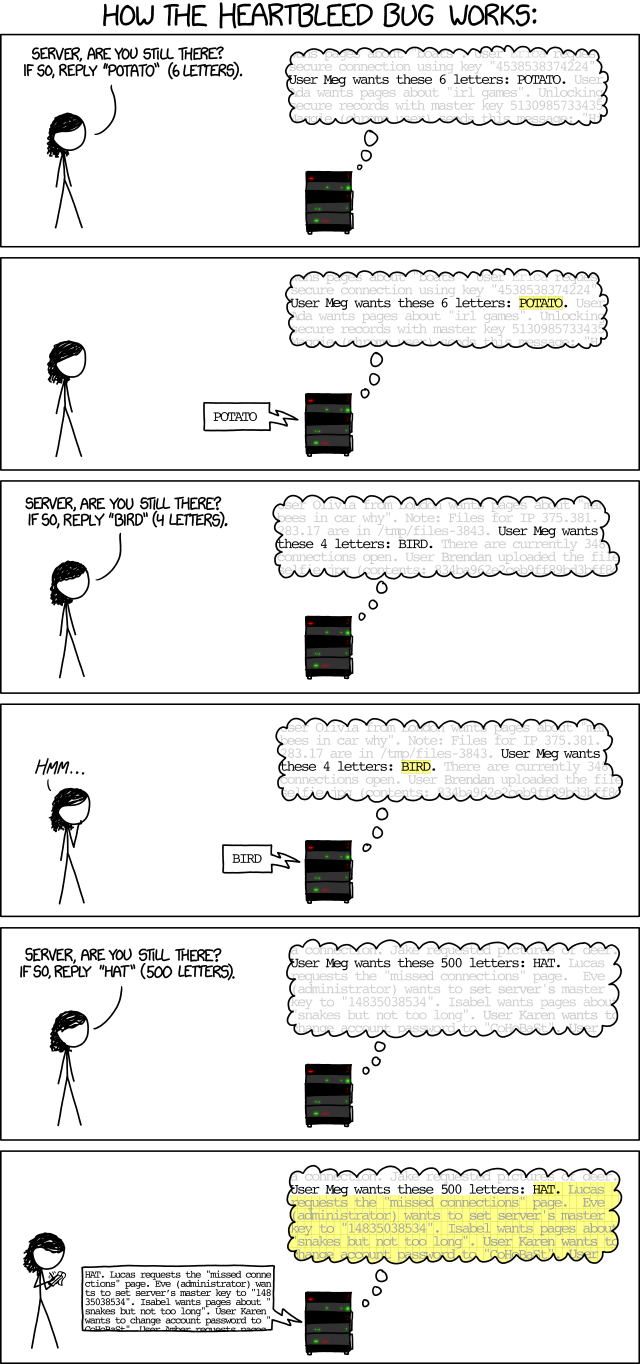
Very simple explanation of the Heartbleed bug

One of the most serious bug in computer and communication technologies: Heartbleed.

Click HERE for an easy description to explain it to your … whoever.