Showing posts with label Schedule. Show all posts

Wednesday, May 21, 2025

The German FNN Steuerbox Version 1.4 (official) is available for just 39 Euro!

The officially published FNN Steuerbox specification (in German only) is available for immediate download (of a personalized pdf) ... if you pay 39 Euro ... really affordable!

The Steuerbox uses a subset of IEC 61850 models and services ... there are three documents related to the Steuerbox available:

https://www.vde-verlag.de/schnellsuche/?suchbegriff=lastenheft+steuerbox 


The document contains a link (on the last page) to additional material: ICD File, certificate and settings XSDs ... WOW ...


This is one of the great news: to get the material for almost free!

In the History element of the ICD file you can see that my granddaughter Jana and I have been involved ...  

Enjoy

Wednesday, November 20, 2019

IEC 61850 Deadband Reporting and Logging - What Does It Provide?

IEC 61850 Reporting and Logging are very useful services to keep the needed bandwidth for messaging low. It is a bit tricky to understand how it works ... due to the fact that there are two documents that need to be studied to understand the function (IEC 61850-7-2 and IEC 61850-7-3). And: You need to know that some changes in the operation of Reporting and Logging happened from Edition 2 to Edition 2.1 (soon to be published as International Standard).

Deadbanding in IEC 61850 provides a filter mechanism that defines, when an analogue value will be reported by the IED (Server side) to another system (Client side).

Edition 2 of IEC 61850-7-3 defines:

"Deadband. Shall represent a configuration parameter used to calculate all deadbanded attributes (for example mag attribute in the CDC MV). The value shall represent the percentage of difference between max. and min. in units of 0,001 %.
If an integral calculation is used to determine the deadbanded value, the value shall be represented as 0,001 % s.
A db value of 0 shall suppress reporting events on the analog value, so that only changes of the range value will lead to events."

Edition 2.1 of IEC 61850-7-3 will define:

"Deadband is a configuration parameter used to calculate deadbanded value 'mag'. The value of 'db' shall represent the percentage of 'dbRef' in units of 0.001 %. Therefore, 'db' = [0...100000], corresponding to [0 %...100 %], respectively. If an integral calculation is used to determine the deadbanded value, the value of 'db' shall be represented as 0.001 %s.
With a 'db' = 0 the attribute 'mag' follows the instantaneous value.
If 'db' is not present in the model, then the deadband calculation is a local issue."

See Tissue Data Base on deadbanding.

"db" = 0 is a dangerous configuration value!! It is like divide by "0". Any (small) change of "instMag" will issue a report or log entry. I am a little bit confused ... but finally it may help with the following use case: Output of the Schedule "ValMV" that is of CDC "MV". See the following figures for some details:


"db" >= 0 could reduce the number of events (reports/log entries) for analogue values. Usually an analogue value is a measurement or a calculated value.

In case of modeling schedules (FSCH in IEC 61850-90-10 / IEC 61850-7-4 Ed2.1) it is required to report/log a scheduled value - which is similar to a measurement ... but it is a non-continuous value (has "jumps" only) ... OK. CDC MV is used for the Output of a Schedule. What is the impact of the "db" value?!? Be careful!
The following figure discusses the impact of trigger option "data change" and "db"=0 as well as "data update":


Finally: If you need to see (as a client) changes only, then "db"=0 is the right configuration. If you want to receive/log a "confirmation" of any new value at the beginning of a new Schedule Interval (SchdIntv) then "data update" is the right configuration.

You need to understand your needs before you decide how to configure deadbanding.

Thursday, May 17, 2018

FNN-Lastenheft "Steuerbox" veröffentlicht

Der FNN-Hinweis "Lastenheft Steuerbox - Funktionale und konstruktive Merkmale" ist jetzt verfügbar und kann zum Preis von 39 € erworben werden.

Das Lastenheft "Steuerbox" liefert die erste Grundlage für ein standardisiertes Steuerungssystem, das in der Architektur des intelligenten Messsystems betrieben werden kann.

Hier für die Leseprobe klicken.
Hier finden Sie den Shop.

Wednesday, May 2, 2018

Die FNN-Steuerbox kommuniziert mit IEC 61850

Die FNN-Steuerbox basiert auf standardisierten Lösungen für den Informationsaustausch. Für die Fernkommunikation mit den Steuerboxeb wurde eine Untermenge an Modellen und Diensten aus der Normenreihe IEC 61850 ausgewählt und näher spezifiziert.

Es kommen Services wie DataSet, Report Control, Log und Log Control, Control ... zur Anwendung. Als wesentliche Modell kommt das Scheduling (Fahrplansteuerung) zum Einsatz.

"In der Niederspannung sind basierend auf den FNN-Anwendungsfällen folgende Teilaspekte relevant.

Fahrplansteuerung

Die Realisierung einer netzdienlichen Fahrplansteuerung dient in erster Linie dem Ersatz der heutigen Heizungssteuerung (Nachtspeicher, Wärmepumpen, Warmwasser) durch das intelligente Messsystem und unterliegt u. a. den Anforderungen einer autarken und zuverlässigen Schaltfahrplansteuerung sowie einer zeitsynchronen Tarifierung.

Steuern einer Einzelanlage Last/Erzeuger in kurzer Zeit

Die Steuerung von einzelnen Lasten und Erzeugern in der Niederspannung kann durch externe Marktteilnehmer erfolgen und ist i.d.R. als unkritisch zu bewerten.

Steuerung von Anlagengruppen in kurzer Zeit

Die Steuerung von Lasten und Erzeugern in der Niederspannung kann durch Gruppierung der Anlagen zu erhöhten Anforderungen führen. Dies kann bei kritischen Netzsituationen erforderlich werden. Entsprechend sind dabei erweiterte Maßnahmen in der Steuerungsarchitektur
zu treffen.

Die dabei betroffenen Stückzahlen sind im Anwendungsfall der Heizungssteuerung mit deutschlandweit ca. 2 Mio. Anlagen sowie einer Leistung von ca. 15 GW erheblich. Im Bereich der erneuerbaren Energien sind derzeit ca. 1,5 Mio. PV-Anlagen installiert, von denen perspektivisch ein großer Teil steuerbar sein soll - Tendenz steigend."

Click HIER für mehr Informationen.

Saturday, August 6, 2016

IEC 61850-90-10 Draft Technical Report on Schedules just published

IEC TC 57 just published the Draft Technical Report:
IEC/TR 61850-90-10 Ed.1.0 (57/1762/DTR)
Communication networks and systems for power utility automation -
Part 90-10: IEC 61850 objects for scheduling

Closing date for voting is 2016-09-30

Schedules establish which behavior (e.g., tariff 1 or 2, mode 1 or 3) or expectation (e.g., forecast) is applied during specified time periods. A schedule consists of a series of entries with a setting for the value of a setpoint, the selection of a particular mode or the value of a parameter for a mode.
There are different ways to operate a scheduled entity based on the following operation principles:

  • The actual values of a scheduled entity (e.g. active and reactive power produced or consumed) are directly controlled using setpoints and controls. For example, the DER system reacts on changes of the setpoints or on controls (e.g. start or stop the DER system) in real time.
  • The functional behavior of a scheduled entity is configured to operate in a mode in which it responds to locally sensed conditions (e.g. Volt-VAr Mode in case of DER) or externally provided information (e.g. prices). 

The schedules offer a very powerful functionality that can be used in many different applications.
Currently we have two major applications in Germany  that make use of the schedules: 
  1. VHPready
  2. FNN Steuerbox
NettedAutomation has implemented the most crucial concepts on an embedded controller used in the HMS gateways.

More to come soon.

Wednesday, June 15, 2016

Schedule Model combined with Setting Group Control Model

Schedules (LN FSCH) and Schedule Controller (LN FSCC) operate on a single Data Object (controllable entity) only. In case you want to set several or even many values with the Schedule Model - you will fail to do so.
Is there a work-around? Yes!
You can control Setting Group Control Blocks through Schedules as shown in the following picture:


The example shows a schedule with 24 enumerated values (1, 2, 3). These values control the Setting Group Control. That way allows to schedule many values (in the example 9 values) with a single schedule! The Schedule Controller LN FSCC is not shown.
This example shows the flexibility of IEC 61850!
Enjoy!
More to come!

Sunday, September 20, 2015

IEC TC 57 Reference Architecture For Power Systems Management And Associated Information Exchange

IEC TC 57 just published a new draft for IEC TR 62357-1 Ed. 2 “Power systems management and associated information exchange – Part 1: Reference architecture” (57/1621/DC)

“The new edition provides updates and defines layered Reference Architecture to help direct longer term goals and activities, specifically to ensure compatibility of all new standards developed in TC57 by benefitting from lessons learned during development of the current standards and their application on actual utility projects as well as through application of other internationally recognized architecture standards.

This edition reflects the progress recently achieved from the international Smart Grids (SG) initiatives and the CIGRE D2.24 large system architecture vision. It also leverage the work done by NIST-SGIP, CEN-CELELEC-ETSI SGCG M490, IEC TC8 Smart Grids Roadmap, and IEC TC8 WG5, WG6, The edition also reflects the most recent editions of the TC 57 standards including IEC 61850 Edition 2 and the IEC 61968, 61970, and 62325 Common Information Model (CIM) standards.”

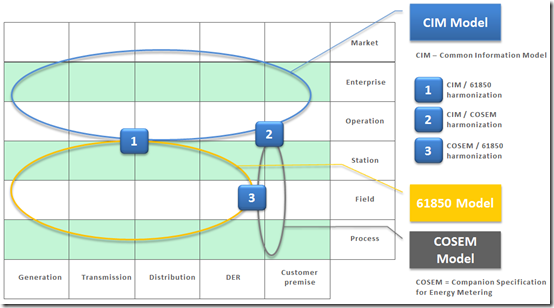
One of the lessons learned is that the three information models (CIM, IEC 61850 and COSEM) need some additional harmonization – a reasonable level has already be reached.
image

IEC 61850 has a very broad application domain and has defined many useful information models that can (and will) be “tapped” by COSEM and CIM applications.

One example that shows that IEC 61850 can be used even for schedules (de: Fahrpläne):

image

These schedules can be mapped from COSEM directly to IEC 61840 logical node FSCH. COSEM may be used for flexible tariffs while IEC 61850 could be used for tariffs as well as for control of switchable equipment like circuit breakers or change settings for loads or generation. The schedule LN is applied in the VHPready 4.0 specification.

More to come soon.

Saturday, October 11, 2014

Just Published: Draft IEC 61850-90-10 Objects for Scheduling

IEC has just published the following document (57/1510/DC):

Draft IEC TR 61850-90-10 – Communication networks and systems for power utility automation – Part 90-10: IEC 61850 objects for scheduling

Comments are expected by 2014-12-05.

Schedules configure a specific behavior during configured time intervals. A schedule consists of a series of entries with a setting for the value of a set point, the selection of a particular mode or the value of a parameter for a mode.

Schedules can be used to allow even more autonomous control of the behavior of DER equipment. They may be sent ahead of time, and then activated at the appropriate time, e.g., for applications like:

  • direct values (e.g. setpoints for P/Q/cosphi)
  • constraints (e.g. do not exceed the maximum value of P/Q/cosphi at a certain time)
  • pricing information (act on constraints)
  • modes (e.g. Volt-VAr curves)
  • parameters of modes
  • predictions or forecasts

This part defines two additional Logical Nodes (schedule and schedule controller):

image

LN FSCH - defining schedules (23 Data Objects)

LN FSCC – schedule controller (3 Data Objects)

It is highly recommended to review this document during the draft stage. It is more convenient to revise the draft now … than waiting until the document has been published as a final document.

Contact your national committee for a copy.