Showing posts with label EES. Show all posts

Monday, February 3, 2025

„Lumpensammler“ in der Stationsautomatisierung mit IEC 61850 - Störmelder

EES (Backnang) bietet eine "super-einfache" Lösung zur Alarmierung von Störungen in IEC 61850 basierten Systemen:

"Neben den Informationen von Feld- und Schutzgeräten, fallen in Schaltanlagen zusätzliche Meldungen an, die an die Leittechnik übermittelt werden sollen. Diese Informationen sollen über die vorhandene Infrastruktur mit dem Protokoll IEC 61850 übertragen werden. ... 

  1. Einbindung von Einzelmeldungen in die Stationsautomatisierung über IEC 61850
  2. Integrierte Relaisausgänge zur Befehlsausgabe
  3. Einfache Parametrierung über integrierten Web-Server
  4. Zuverlässiger Betrieb durch störfestes Design und angepasste Signalverarbeitung
  5. Hohe Funktionalität und Skalierbarkeit von 8 bis zu 192 Meldungen ..."

HIER kommen Sie zu weiteren Informationen.

Dieses Beispiel zeigt, dass IEC 61850 auch für einfache Aufgaben angewendet werden kann!

„Rag-man“ in Substations Applying IEC 61850 - Fault Annunciators

EES (Backnang, Germany) offers a nice solution for simple and easy alarming in IEC 61850 based systems:
"In addition to the information provided by the field and protection devices over IEC 61850, different single alarms incurr in switchgear stations, e.g. from the station supply switchboard section or general alarms like temperature monitoring or door contacts. ... 
  1. Simple integration of fault annunciators into IEC 61850 structures – through copper or optical fibre connection
  2. Integrated relay outputs for issue of commands
  3. Easy parameterisation through integrated web-server
  4. Reliable operation through immune design and adapted signal processing
  5. High functionality and scalability from 8 up to 192 alarms ..."
Click HERE for additional information.
This product shows that IEC 61850 is applicable for simple and easy to use applications.

Monday, August 5, 2019

IEC Draft TR 61850-90-9 - "IEC 61850 for Electrical Energy Storage Systems" Published

IEC TC 57 just published the 138 page IEC Draft TR 61850-90-9

IEC 61850 for Electrical Energy Storage Systems

57/2128/DTR
Voting closes 2019-09-27

This is one of the next crucial extensions for DER-Models of IEC 61850-7-420. This TR will be merged into the 7-420 later on.

The Introduction states: " ...This technical report is primarily based on the recommendation 5.7.4. “interface, control and standard data elements”, of the IEC white paper ”Electrical Energy Storage” published in December 2011 by the MSB. The recommendation proposes the necessity of a standardization of interfaces between storage and other grid elements, protocols for data exchange and control rules, and data elements for input, output and control information supplied by or to storage systems. ..."

Click HERE for the mentioned IEC White Paper.

"This technical report describes IEC 61850 information model for electrical energy storage systems (EESS). Therefore the report only focuses on storage functionality in the purpose of grid integration of such systems at the DER unit level. Higher level Interactions are already covered in IEC 61850-7-420. ... "

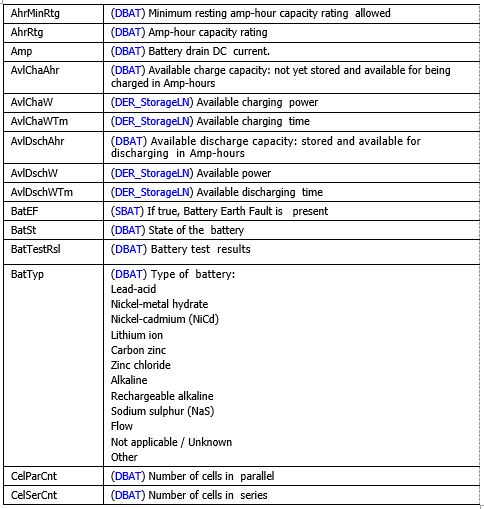
The draft defines more than 150 new Data Objects. Excerpt of the first 15 Data Objects:


The blue marked text refers to the Logical Node from which this Data Object is inherited.

This document refers to the standards IEC 61850-7-x and defines additional very crucial information for the configuration, control, monitoring of a battery system.
It is very crucial for the success of the DER models to get implementation and application experience with these very comprehensive and complex models.
Taking into account that the mentioned White Paper was already published in 2011, we learn a crucial lesson: It took a lot of time to get where we are today. And it will take years to get these definitions implemented and used in the power delivery systems. In the mean time you need to tap the experience of engineers that understand the possible use-cases that can harvest the benefits of applying these standards.