Thursday, April 17, 2014

DRAFT Release 3.0 of the “NIST Framework and Roadmap for Smart Grid Interoperability Standards” out for comments

The next release of the famous framework and roadmap for Smart Grid Interoperability Standards has been drafted and published for comments on April 15, 2014.

The entire 255 pages draft version of the NIST Framework and Roadmap for Smart Grid Interoperability Standards, Release 3.0 (Draft), is available online here.

"We worked closely with the European Union to harmonize the NIST conceptual model with the one the EU is developing," says NIST's Paul Boynton. "We want both models to reflect each other, which is important so that manufacturers on both sides of the Atlantic will be able to sell devices overseas."

NIST seeks comments on the draft NIST Framework and Roadmap for Smart Grid Interoperability Standards, Release 3.0.  In particular, comments on technical, editorial, or general issues.

Comments must be received on or before 5:00 p.m. Eastern Time on May 30, 2014.

Click HERE for further information on the process … how to comment …

One of the core contents deals with standards that support the vendors to build interoperable devices that could be applied in North America, Europe, and all over (!) is Table 4-1 (Identified Standards). The list grew from 34 to 74 standards from Release 2. The list refers to the following standards of primary interest in the context of this blog:

#12 IEC 60870-6-503 TASE.2 Services and protocol
#13 IEC 60870-6-702 Functional profile for providing the TASE.2
#14 IEC 60870-6-802 TASE.2 Object Models
#15 IEC 61850-1
#16 IEC61850-2
#17 IEC61850-3
#18 IEC61850-4
#19 IEC61850-5
#20 IEC61850-6
#21 IEC61850-7-1
#22 IEC61850-7-2
#23 IEC61850-7-3
#24 IEC61850-7-410
#25 IEC61850-7-420
#26 IEC61850-8-1
#27 IEC61850-9-2
#28 IEC61850-10
#29 IEC61850-90-5
#30 IEC 61968/61970 Suites
#31 IEEE 1815 (DNP3)
#64 IEC 62351-1
#65 IEC 62351-2
#66 IEC 62351-3
#67 IEC 62351-4
#68 IEC 62351-5
#69 IEC 62351-6
#70 IEC 62351-7
#?? IEC 61850-7-4 is missing – commented on it already.

15 out of 74 entries are referring to IEC 61850 standards! IEC 61850 conformant products and based systems are playing already a major role in the North American market – in the public utility world and in the power distribution in factories and production plants.

All in a sudden (as it seems to me!) managers in production facilities have figured out that electric power is very crucial for them – to save money or to increase profits.

Sunday, April 13, 2014

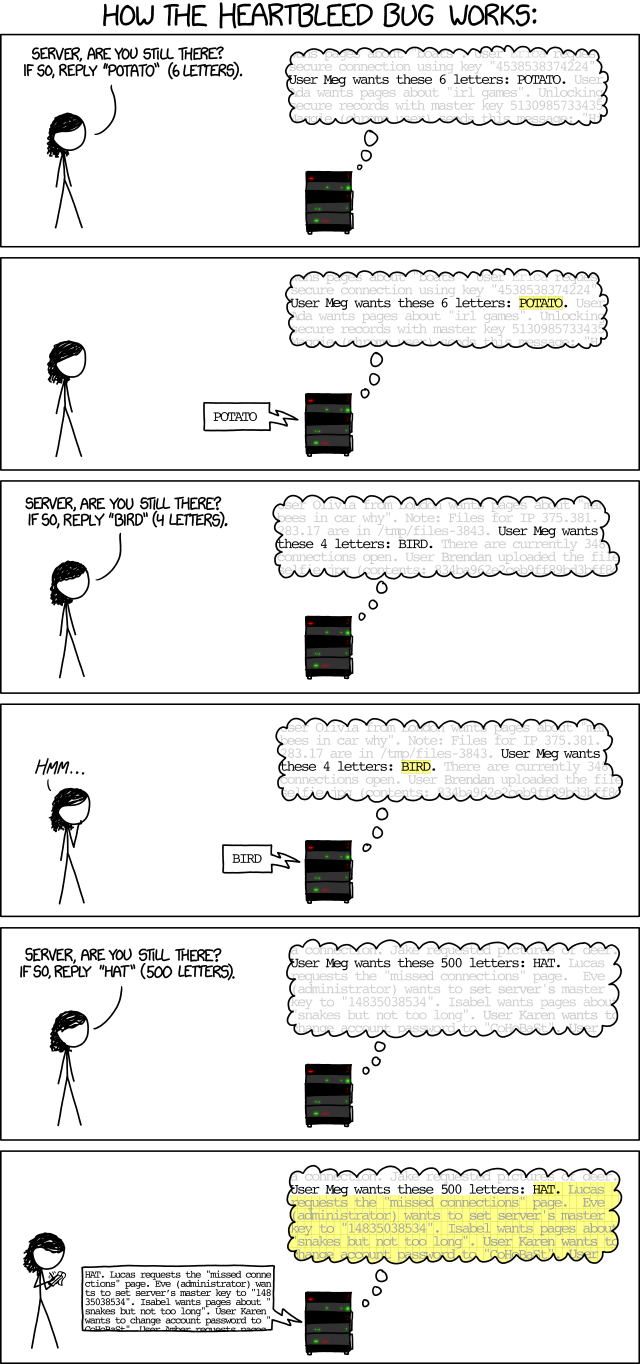
Very simple explanation of the Heartbleed bug

One of the most serious bug in computer and communication technologies: Heartbleed.

Click HERE for an easy description to explain it to your … whoever.

Tuesday, April 8, 2014

Brief Report from the Hannover Messe (after second day)

This is the fifth Hannover Fair for Beck IPC demonstrating IEC 61850 solutions. In 2010 Beck presented the first “IEC 61850 @ Chip”. Now – four years later – the market is looking for easy to use and reasonable priced IEC 60870-5-104, DNP3, IEC 61850, IEC 61400-25, … solutions!

The booth at the Hannover Messe in 2014 is quite small – but visited by many experts from experts users and manufacturers of many application domains from all over: Power transmission, distribution, renewable power, virtual power systems, building automation, asset management, …

… Beck IPC is partner of the Smart Grid Forum:

image

… the booth was visited by almost 100 experts during the first two days:

image

The key products are the com.tom devices that could be used to collect the process data, process them and communicate the results through IEC 60870-5-104, IEC 61850, IEC 61400-25, cloud portal, … Gateways between these protocols.

In case you want to see the most simple IEC 60870-5-104, IEC 61850, … in action, please visit the above booth C35/7 in Hall 13.

I look forward to meeting you at the above booth.

Skyrocketing growth: Beck IPC offers New Free of Charge Workshops end of May 2014 in German and in English

The interest in applying IEC 60870-5-104, DNP3, IEC 61850, IEC 61400-25 … using products of Beck IPC is growing skyrocketing!

The third free of charge Workshop in German is scheduled for:

Datum: 27. Mai 2014
Ort: Wetzlar, etwa 70 km nördlich von Frankfurt
Zeit: 10:00 Uhr - 17:00 Uhr
Programm (Deutsch).

the second free of charge Workshop in English for:

Date: 28. May 2014
Location: Wetzlar (Germany), some 70 km north of Frankfurt
Time: 10:00 h - 17:00 h
Program (English).

Registration information for both events can be found under the above links.

Tuesday, April 1, 2014

Progress in publishing IEC 61850-90-2 Substation to Control Center Communication

The IEC TC 57 WG 19 is working on the final draft Technical Report for the communication between Control Centers and underlying systems like Substations, Power Plants, and other applications:

IEC Draft TR 61850-90-2:

COMMUNICATION NETWORK AND SYSTEM FOR POWER UTILITY AUTOMATION –
Part 90-2: USING IEC 61850 FOR THE COMMUNICATION BETWEEN SUBSTATIONS AND CONTROL CENTRES

Big utilities are waiting for the publication of this part. They are looking for a seamless communication at various levels.

This technical report provides a comprehensive overview of the different aspects that need to be considered while using IEC 61850 for information exchange between substations and control or maintenance centres or other system level applications. In particular, this technical report:

  • Defines use cases and communication requirements that require an information exchange between substations and control or maintenance centres
  • Describes the usage of the configuration language of IEC 61850‑6
  • Gives guidelines for the selection of communication services and architectures compatible with IEC 61850
  • Describes the engineering workflow
  • Describes the links regarding the Specific Communication Service Mapping (SCSM)

The utility industry is waiting for the final version. Today, an expert of a big utility stated the following: “From my view, having the alternative to IEC 60870-5-104 and IEC 61850-90-2 for the communication between the substation and the control center my recommendation will be in favour of the 90-2 which allows you to use all 61850 services available comparing with 104 which is more restricted.”

I fully agree with that statement.

By the way, an easy to implement com.tom WEB-PLC based gateway from IEC 61850 (for the down-ling from a gateway) to IEC 61850 (for the up-link to a control center) will be shown during the Hannover Messe next week (07-11 April, hall 13 booth C35/7):

image

The gateway/proxy server provides all crucial features of IEC 61850.

I look forward to showing you the gateway – meet you there.

Friday, March 28, 2014

Be Smart – See IEC 60870-5-104 and IEC 61850 in Action at the Hannover Messe 2014

The Hannover Messe 2014 will continue to offer mature solutions for many needs in the power delivery system – generation, transmission, distribution, usage, … in the public grids as well as in production facilities, ships, harbors, transportation, … Energy is all over! Without energy I could not write this post … nobody would receive the crucial message for a meeting in Hannover.

What you could see there, is described by Günther H. Oettinger, EU Commissioner for Energy in his welcome message of the brochure for the “Smart Grids Forum” :

“ … The critical importance of smart grids is reflected in the Smart Grids display area [Hall 13, stand C35] stand at HANNOVER MESSE’s Energy show. The display area presents technologies that can intelligently integrate and … The Smart Grids display area at HANNOVER MESSE facilitates this dialogue and knowledge-sharing with key input from noted experts from industry, the energy sector, science, research and government. It is my pleasure as EU Commissioner for Energy to take over the patronage of the Smart Grids 2014 and I wish all partners stimulating and profitable discussions at this important exhibition area of the HANNOVER MESSE.”

Some 50 speeches will open your eyes for the needs and solutions. Well known experts from all over will present and discuss the Smart Grid from different perspectives.

Click HERE for the Brochure on the Smart Grid Exclusive themed presentations.

There is also an integrated exhibition of companies that present the latest solutions for smart(er) grids. One of them is Beck IPC at booth C35/7 – just next to the Forum.

Beck IPC and NettedAutomation show the latest developments in using cloud computing, portal for energy applications, smart controller devices supporting Logic, Modbus, M-Bus, IEC 60870-5-104/101, DNP3, IEC61850, IEC 61400-25, … to build highly integrated and distributed applications including gateways between all solutions:

image

The easiest solution is to use a WEB-PLC and manage the signals to be communicated by the various appropriate communication protocols:

clip_image001

Click HERE for an introduction to the use of the WEB-PLC for the above protocols [pdf] with the title:

"The Beautiful Simplicity of the Integration of Modbus, DNP3, IEC 60870-5-104, and IEC 61850 into a powerful WEB-PLC operating on an Embedded Controller"

Click HERE for an overview on IEC 61850 supporting solutions.

I look forward to meeting you at the Hannover Messe Hall 13, Booth C35/7.

Friday, March 21, 2014

The Beautiful Simplicity of the Integration of IEC 60870-5-104 and IEC 61850

The experience has shown that manufacturers are still shying away from the high costs and long time required for the development of new products based on standards like IEC 61850, IEC 60870-5-104, and IEC 61400-25 (Wind Turbines) because the implementations and applications are quite complex.

For these reasons, a team at NettedAutomation developed a web-based integration tool based on Beck IPC’s com.tom WEB-PLC that significantly streamlines the application of these and other standards and the implementation of simple logic functions that consume and generate data communicated with a variety of protocols. The solution can be used to build various kinds of IEDs for monitoring, control, data concentrators, data aggregators, and gateways.

An 18 page paper describes „The Beautiful Simplicity of the Integration of Modbus, DNP3, IEC 60870-5-104, and IEC 61850 into a powerful WEB-PLC operating on an Embedded Controller“

Click HERE to download the paper [pdf, 2.2 MB]

The com.tom with IEC 60870-5-104 and IEC 61850 are available – see the following website:

http://www.com-tom.de/products.php

image

These standards are available on most com.tom … DNP3 is available soon. The programming with CoDeSys (IEC 61131-3) and C/C++ is also available.

Saturday, March 15, 2014

Bandwidth Usage – IEC 61850 Object References versus Indexes in Messages

Beck IPC and NettedAutomation conducted two workshops on the latest development of IEC 61850 and IEC 60870-5-104 monitoring and automation IEDs and gateways. Experts from 12 companies (users and vendors) attended the workshops. The attendees appreciated the inside view into the standards and how easy it is to implement standard conformant IEDs.

One attendee responded the day after:

“Dear Mr Schwarz, I had a safe return fortunately. Thanks again for your documents and your very interesting presentations yesterday. It is very likely that I contact you in the near future for some questions/help.”

During the first workshop there was a very crucial question on the long names that are used as references to signals (data attributes) like: “MyLogicalDevice/QE1XSWI5.Pos”: How do these long names impact bandwidth needs and consumption? It seems to be quite in-efficient to use IEC 61850 for low bandwidth communication channels! Or?

Here is the solution for Reporting (Meldungen) in IEC 61850: The Report Message uses DataSets to describe the semantic content of the message and the syntactical position of each member of the DataSet. The example below shows five members. The order of the members in the DataSet is important!

image

A single change in a one of the signals represented by a hierarchical reference, e.g., “MyLogicalDevice/QE1XSWI5.Pos” causes a spontaneous report message with the value of exactly this member (Boolean=True in our example). The POSITION of the member within the DataSet is marked in an inclusion bitstring (or Index) in the message. For the five members we need one octet for the bitstring. The message also carries the name of the DataSet “SwitchPositions”.

The Client can interpret the semantic of the single Boolean (=True) by just looking into the DataSet configuration. The member number 5 means: “MyLogicalDevice/QE1XSWI5.Pos” (of the server). The client needs to understand the syntax (position of the member in the DataSet) and the semantic of the received value(s). The client uses the Configured IED Description (.cid) to understand the shipped package (report).

Any question. Please keep in touch.

For GOOSE and Sampled Value messages it is even more efficient: by just sending the values of all members of a DataSet (in the order of the DataSet) there is no need to provide any identifier (name or index) in the messages. The semantic is determined by the order of the corresponding DataSet. So, subscribers need to receive in the GOOSE or SV the reference of the DataSet used. The efficiency much better than what many people expect – people that know the efficient encoding of IEC 60870-5-104 or DNP3.

That’s it. You want to learn more about IEC 61850 and related standards – and how to implement them, please check the program for the next hands-on training on 07-09 May 2014 in Frankfurt/Germany.

Tuesday, March 11, 2014

The number of the day: 110

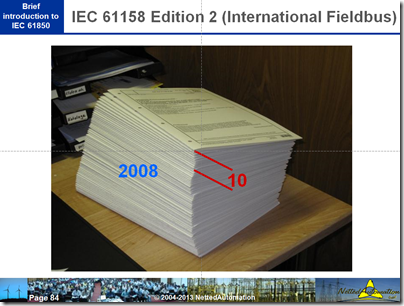
The international fieldbus standard series IEC 61158 (Industrial communication networks –Fieldbus specifications ) and IEC 61784 (Industrial communication networks – Profiles) comprise 110 parts – as listed in the FDIS of part IEC 61158-1 (Fieldbus specifications – Part 1: Overview and guidance for the IEC 61158 and IEC 61784 series). IEC 61158 comprises 82 parts and IEC 61784 has 28 parts.

The part 1 of IEC 61158 states that “The IEC 61158-6 (application layer) series defines a number of distinct and non-interoperable fieldbus application protocols.” This is true for most of the specified solutions: they are not interoperable.

The fieldbus standard series defines 50 different (usually non-interoperable) profiles …

In contrast IEC 61850 defines:

  • ONE set of interoperable information models independent of protocols,
  • ONE configuration language mostly independent of protocols,
  • ONE set of abstract services,
  • THREE sets of protocols for three different applicationsONE for client/server, ONE for GOOSE, and ONE for Sampled Values.

Devices that implement IEC 61850 are usually interoperable – there are exceptions, of course. The standard is intended to reach a very high level of interoperability. Lesson learned from the Industrial communication networks: prevent the proliferation of standardized solutions.

http://en.wikipedia.org/wiki/International_standard describes the purpose of international standards:

“ … Technical barriers arise when different groups come together, each with a large user base, doing some well established thing that between them is mutually incompatible. Establishing international standards is one way of preventing or overcoming this problem. …”

This is exactly what the experts that define IEC 61850 are doing for almost 20 years – to the benefit of the global energy delivery market! This objective is well received and appreciated all over.

Friday, March 7, 2014

IEC 61850 at the Hannover Messe 2014

The Hannover Messe will be open from 7-11 April 2014. You are invited to visit the Beck IPC Booth in Hall 13 Stand C35/7. One crucial display will be the wide range of small and efficient multi purpose devices (com.tom) with embedded controllers.

You will see IEC 60870-5-104, IEC 61860, Modbus, … with integrated security (openVPN, …) in action. The com.tom with a WEB-PLC will be presented by NettedAutomation to show the beautiful integration of standards-based automation and monitoring devices as well as gateways.

A comprehensive video clip with an Introduction to IEC 61850, Models, Configuration, Application of a real power quality monitoring with a Janitza PQ Monitor connected with Modbus, WEB-PLC, and Remote access to a com.tom has been posted yesterday. This video helps to get a clue what the standard is all about and how easy it is to get a “non-IEC 61850 device “wrapped” in a nice sugary coating of IEC 61850”.

You will see this and many other applications in action at the Hannover Fair.

Format: mp4 with a resolution of 1180 x 884

- Complete Video (110 MB and 37 Minutes)

I have split this long video into three parts with the same content:

- Part 1 (of 3) Start, IEC 61850 Information Models, and Demo setup (40 MB and 10 Minutes)

- Part 2 (of 3) How to use the Configuration Language SCL (33 MB and 11 Minutes)

- Part 3 (of 3) Implementation with com.tom WEB-PLC (47 MB and 17 Minutes)

A video on building a gateway from IEC 61850 to IEC 60870-5-104 will be presented soon.

Thursday, March 6, 2014

Brief EPRI Report on Standards of DistribuTech 2014

EPRI has published a Brief Report of DistribuTECH 2014.

It seems that a hot topic was “DATA” … data from everywhere of everything! Sure there is a need to share the pool of “Big Data”. I have heard about a SCADA project that receives Terra Bytes of “big Data” from a huge wind power park trough IEC 61400-25. This seems to be “Big Data” and “little information” … good for hardware manufacturers.

The EPRI Brief reports from the DistribuTech 2014:

“This was also another good year for standards. The vendor community has heard loud and clear that standards are a preference of electric utilities and the vendors have done a good job of promoting where they are using standards including DNP3, IEC 61850, IEC 61968/61970 (the CIM), MultiSpeak, and more. One relatively new standard that had a strong presence was OpenADR (Open Automatic Demand Response).”

Click HERE for the complete report.

I hope that they are looking at useful information rather than bunches of Data – that just may tell the receiver: nothing has changed, nothing has changed, nothing has changed, … stop here and make it smarter:

image

This is one aspect of the philosophy of IEC 61850 – which needs to be understood by more people … it will take some time to understand this.

Tuesday, March 4, 2014

Have you heard about Fuzz Testing of Protocols?

We have to learn new terms every day. One new term is now used quite often: Fuzz testing.

What is it? In Wikipedia you can read:

Fuzz testing” or fuzzing is a software testing technique, often automated or semi-automated, that involves providing invalid, unexpected, or random data to the inputs of a computer program. The program is then monitored for exceptions such as crashes, or failing built-in code assertions or for finding potential memory leaks. Fuzzing is commonly used to test for security problems in software or computer systems.”

So, it is no surprise to read about fuzz testing and protocols used in the power industry. One discussion is about the fuzz testing and DNP3.

Click HERE to read what experts discuss [Post on Digitalbond website on DNP3].

I have discussed quite often the issue of security and improving the quality of protocol implementations and applications, e.g.,

Is Security really a big Issue in the Power Industry?
Security Measures in Power Grids – often ignored

There is another (related issue): Who is in charge to define the detailed test-cases for conformance testing IEDs?

  • Is it a users group? Maybe.
  • Is it a test lab accredited by a users group? Hopefully not!
  • Is it the vendor of IEDs? This would cause some issues in the future.

The organization that has published a specification and that is responsible for the maintenance MUST define the details of test cases and decide what should be tested.

In the case of DNP3 it is IEEE, because DNP3 is now published as IEEE standard 1815. In case of IEC 61850 it is the IEC TC 57 and especially the working groups 10, 15, 17, 18, and 19.

This means: Users have to get more involved in the standardization work and in the testing activities to make sure that the testing follows the standards – and not vice versa. Sure: issues found during testing have to be fed back to the standardization groups.

What does Self-Description in IEC 61850 and IEC 61400-25 mean?

The other day I was asked to explain the self-description to a larger group of SCADA and Asset management experts. The requirement was, to do it in some 3 minutes. I have many ways to explain it: slides, live presentation, or just a white-board.

I decided to produce a short video clip – because I have the right equipment on my desk and convenient tools to produce a video.

The result is now online and can be viewed.

Click HERE to view the 4 minutes clip.

I have planned to provide more video clips showing benefits of IEC 61850 and IEC 61400-25 and IEC 6070-5-104, …

Friday, February 28, 2014

What are the Benefits of IEC 61850?

The question “What are the benefits of IEC 61850” has different flavors and multiple answers – it depends on what are you looking for. If you are looking just at the communication protocol, there are answers like:

  1. The client/server protocol (MMS) is a unified solution standardized some 25 years ago. It is a stable standard – unlikely to change in the future and accepted all over for many years.
  2. The GOOSE messaging is very unique and provides real-time information exchange in the msec range – accepted all over
  3. The Sampled Values messaging provides a unique solution for exchanging samples of currents, voltages, vibration measurements accepted all over.

If you are looking at the information models, there are really many crucial models defined and in use. No other standard (I am aware of) has such a rich set of information models that expose process information in a standardized way – all over accepted.

There is – of course – the crucial issue on the configuration language. In this post we will discuss the benefit of a unified model that allows to hide the different vendor-specific signal lists for Modbus communication in two different power quality meters. In the end, the unification of specific information profiles (or subsets) for, e.g., the electrical measurements makes IEC 61850 different compared to any other solution I know.

The power quality monitors used are: Janitza UMG 604 and Acuvim II. Both meters provide many measurements of the electrical system. The signals can be communicated by Modbus. Usually each vendor has a different approach to define the lists of signals – and especially the indexes used for the vary same signal is quite different and have to be mapped manually to any application – again and again. There is no way to agree on a single unified Modbus signal list that can be applied all over. The next figure shows the two devices, their signal “phase voltage” with different identifiers and indexes.

image

The unification of the information model is implemented in a simple gateway (com.tom BASIC 5.1). The gateway is based on a WEB-PLC that maps the incoming Modbus signals to IEC 61850 models. The IEC 61850 model uses the same logical node class and type. The type MMXU_0 is the subset of the MMXU class used in this application (of four data objects – as can be seen in the icd file). The instance MMXU1 can easily be “copied” to build a second instance: for the Acuvim II meter. Both instances use a unique MMXU logical node type (contained in the icd file). The model can be used to configure the IEC 61850 server device and an IEC 61850 client (in this case the IEDScout) as shown in the next figure.

image

The gateway solution is reasonable in case just a limited number of applications need the information communicated by IEC 61850.  The next step could be to integrate the “gateway” into the meter housing, as shown in the next figure:

image

The “heart” of the gateway (we use) is the Beck IPC@CHIP controller that could be applied as a subsystem in the meter. It manages the complete IEC 61850, IEC 61400-25, IEC 60870-5-104 or DNP3 communication.

The IEC 61850 models are the same as before in the case of using a separate gateway box. From a client point of view there is only one difference: there are two IP addresses and two IED names to take into account.

The configuration of the client could benefit from the unified information model contained in a standardized machine readable format (.icd). When you google for power meters with a Modbus interface (or any other fieldbus-like) interface you will get as many different signal list as solutions. In our case we can easily unify the information that comes from many different meters.

By the way, the unified model can be fed not only by a Modbus communication interface. Any other signal list communicated by the myriad of solutions could easily be unified! It does not matter how many different protocols you have to take into account – the very same IEC 61850 profile could serve them all. Define it once and use it for ever and all over.

The WEB-PLC based solution explained here is available – I have tested the concept with several devices: meters, monitoring devices, control devices. This approach could be applied right away – and you pay while you go. To get started with a extra box is in the range of some hundred Euro plus some time to understand the approach and learn how to get started with the product. The IPC@CHIP including IEC 61850 client and server (GOOSE and SMV), IEC 60870-5-104 server, and Modbus client costs less than 100 Euro – too cheap to ignore.

Let people define new protocols and … IEC 61850 can unify them all! The next days I will post a report on a hierarchical system with a Janitza UMG 604 and fan heater as the process, a com.tom device to monitor and control the process (with an IEC 61850 server), an a com.tom on top that could be used as a (proxy) gateway to the underlying com.tom (providing an IEC 61850 client, IEC 60870-5-104 server and an IEC 61850 server). The gateway interoperates in a plug&play manner with the underlying IEC 61850 IEDs.

I don’t fear the following situation:

image

nor this …

image

It is a change for IEC 61850 to unify the proliferation!

More to come shortly – stay tuned to this blog.

I had to wait almost 30 years to have a real simple and easy to use “MAP” solution running on my desk:

image

The MAP/TOP Demonstration in 1986 was too early! Definitely!

Wednesday, February 26, 2014

DIN und DKE: Brücken bauen zwischen Forschung und Normung

DIN und DKE führen am 26. Mai 2014 in Berlin einen “Workshop für Forscher und Multiplikatoren zur Relevanz von Normung und Standardisierung für den Forschungstransfer” durch.

“Der Workshop wird das Thema aus verschiedenen Perspektiven beleuchten und die Möglichkeiten der Zusammenarbeit zwischen Forschung, Normung und Standardisierung präsentieren. Projekte aus den Bereichen Risikomanagement, Logistik, Energiewende und Smart Grid werden über ihre Anwendung von Normung und Standardisierung als Verwertungsinstrument berichten.”

Hier für mehr Informationen klicken.

Aus Sicht der Normenreihen IEC 60870-5-104, IEC 61968, IEC 61970, IEC 61850 und IEC 61400-25 kann auch die Forschung als Verwertungsinstrument für Normen eingesetzt werden. Für verfügbare und – vor allem – international anerkannte Normen sollte die Forschung die Ergebnisse verwerten und für Anwendungen einsetzen, die helfen, die Energiewende und Smart(er) Grids voranzubringen.

Doppel- und Dreifachnormung durch die Forschung ist kaum zielführend!

Wednesday, February 19, 2014

IEC 61400-25-4 Mappings: IEC 610870-5-104 AND/OR IEC 61850-8-1 MMS?

As an engineer I have been involved in many discussions on protocols – for the last 30 years. Sometimes it seems to be better to just ignore the arguments pro and contra a specific solution. The mapping in IEC 61850 uses ISO 9506 (MMS) as the “transport layer” of the messages required for IEC 61850 client-server applications.

In IEC 61400-25-4 (WIND TURBINES – Part 25-4: Communications for monitoring and control of wind power plants – Mapping to communication profile) there are the following five options defined:

  • Web-services
  • OPC XML DA
  • IEC 61850-8-1 (MMS)
  • IEC 60870-5-101/104
  • DNP3

Depending on the company you will find one or the other solution. Most applications use MMS – not all.

Yesterday I attended a presentation of a big (well known wind turbine manufacturer). The presentation showed the use of IEC 60870-5-104 to communicate information defined in IEC 61400-25-2 (Information Models). The fourth option expressively allows to use 104. So, does this mean the market will split in five parts? Why should this happen?

The following application running on the WEB-PLC of the Beck IPC com.tom shows that it is quite easy to support one or the other solution or BOTH – at the same time.

The com.tom 5.1 provides two servers: IEC 60870-5-104 AND IEC 61850. The decision which signal to communicate by which protocol is engineered by drawing a line (on a standard web browser!) from the source information (coming from the Janitza UMG 604 power quality analyzer) to the corresponding output signal: IEC 60870-5-104 and/or IEC 61850:

image

The two clients on top (left QTester104, right IEDScout) can tap the same information. It is no question anymore: either ONE or the OTHER. The communication of the signals can be decided by drawing a simple linewithout programming a single line in C/C++ or IEC 61131-3. Sure, the applications to be run on the com.tom family of products can also be programmed in IEC 61131-3 (CoDeSys) and C/C++ … which means: it is more work.

image

The WEB-PLC Object at the bottom right in the above figure can be an IEC 61400-25-2 object like: WGEN1.PhV.cVal.mag. For the platform these are all just names. I will provide more examples soon.

This solution shows that there is no need to fight for one or the other solution: just use whatever fits with your needs. DNP3 will be available soon … Modbus RTU is already used (see above).

Workshop of USE61400-25 Users Group in Hamburg was a very big Success

The workshop on IEC 61400-25 (IEC 61850 extensions for wind turbines) at Senvion (former RePower, Hamburg) was a very big success! The 40 attendees appreciated the high level of presentations on several aspects of the standard: Information Models, Modeling, Information exchange services, Mappings, Applications, solutions, testing, and certification.

The USE61400-25 Users Group was very active in promoting the standard and how to reach a high level of interoperability and – of course – conformity!

It is very likely that this workshop has inspired several people present that are not yet members of the Users Group.

Membership in this Users Group provides an excellent platform to exchange experiences, educate experts, to support the standardization process, and the testing of devices.

Check the Users Groups website for news – you will find also news about the wind power applications on this blog. Several people thanked me for the great content they find on this blog! You are welcome!

Stay tuned.

Saturday, February 15, 2014

New VHPReady Industrieforum to push IEC 60870-5-104 and IEC 61850

The specification “Virtual Heat and Power” (VHPReady) has been developed by Vattenfall and published as Version 3. The specification is a profile for a specific application. It has gained crucial industry support. The specification is the major input for the newly established “Industrieforum VHPReady”  this week Wednesday during the E-World conference in Essen.

The Virtual Power Plant combines block-type combined heat and power (BCHP) plants and heat pumps to create an interconnected, flexible system with centralized control. It is the first power plant which is capable of generating power during heat generation using the connected BCHP plants while making good use of excess wind and solar electricity by way of heat pumps.

The two communication options are: IEC 60870-5-104 and IEC 61850.

Founding members of the Industrieforum are well known organizations and companies:
- Fraunhofer FOKUS
- 2G Energy AG
- 50Hertz Transmission GmbH
- Beck IPC GmbH
- Bosch Software Innovations GmbH
- Energy2market GmbH
- E.ON Connecting Energies GmbH
- IT&I GmbH
- LichtBlick SE
- Optimax Energy GmbH
- PHOENIX CONTACT Electronics GmbH
- SSV Software Systems GmbH
- Vattenfall Europe Wärme AG
- WAGO Kontakttechnik GmbH & Co. KG
- Younicos AG

Download the VHPReady 3.0 specification in English [PDF, 650 KB] and in German [PDF, 650 KB].

Some discussions can be found here: